Vapid truth in a world crying out for beauty
“For since the most beautiful and supreme good of all is the Divinity Itself, to which incline all things that have a tendency toward what is beautiful and good, we therefore say that the mind, as being in the image of the most beautiful, itself also remains in beauty and goodness so long as it partakes as far as is possible in its likeness to the archetype; but if it were at all to depart from this it is deprived of that beauty in which it was.”
- Gregory of Nyssa, On The Making Of Man
•••••
In my last post I tried putting words to the reality that, in my cultural context in Tennessee, discovering God as God is seems to be more likely on the margins of or outside acceptable religion. In the coming months I’ll be making occasional side quests from that post; so, if you missed it, I suggest reading before continuing here.
Part of the challenge is that people inside acceptable religion seem mostly interested in truth claims and the wielding of those claims for social gain, which creates countless problems, including:
“This de-churched frustration with those who are churched seems to center around two realities: (1) the accepted theology and church culture of the day have not been wrestled with in most churches, as we all seem to know subconsciously that if they were it would lead to a crisis of religion, and (2) there is little knowledge and even less appreciation for the struggles of people who live outside the walls of acceptable religion.”
There’s not a single reason that explains why things are this way; however, it’s clear the obsession with having and wielding the truth plays an outsized role. At best, it leads people to miss the forest for the trees and have less to offer to the world. At worst, it inflicts immense harm on churches, families, and even the whole of society.
What if our desire was for something else instead? Something even bigger and better than truth? It seems that merely pursuing more than the utility of our understanding of truth would, at the very least, be a step in the right direction. So let’s start here within the context of a recent example, one that is a near-perfect summary of the issue at hand.
Welcome to adaptation torment
Some of you know that Netflix’s film adaptation of The Chronicles of Narnia: The Magician’s Nephew arrives next year. Greta Gerwig is an exceptionally talented director and the book tends to be one of the more beloved of the series —it’s my personal favorite, at least— so there’s plenty to be excited about.
Like most fan bases, The Chronicles of Narnia has its “purists.” (I use that term loosely and in the interpretative sense, not as an insult.) These are people who have read the books countless times because they genuinely love them, know the core themes and characters by heart, and can quickly pull up anecdotes from the stories in everyday use. Purists tend to be skeptical of film and TV adaptations because they know, rightly, that changes to the story always have to be made for a visual format. Yet, despite their critical eye, they are usually more than capable of enjoying parts of an adaptation they think were handled well and giving credit where credit is due.
Then there are those who believe they are purists but really aren’t. Some of them know the subject matter quite well, at least in a plain and literal sense, although most don’t seem to know the story or author as well as they believe they do. This is because their love for the story isn’t rooted in the story itself, so much as in what they think the story represents. They’ll even argue with the author —in this case a dead author— about the story in a way that is very off-putting and self-defeating. One such example is people boldly insisting The Lord of the Rings or The Chronicles of Narnia are allegory, despite both Tolkien and Lewis saying their masterpieces aren’t allegory. If an adaptation or interpretation doesn’t speak precisely to their very narrow and often self-serving understanding of the story, then nothing will make these kinds of people happy, including the parts they fully agree with.
This mentality probably sounds familiar. It’s very similar to the culture-warring and apologetic approach and tone common in parts of American Protestantism —especially white evangelicalism, a dominant type of acceptable religion— when it comes to views of God, understandings of reality, and the purpose and meaning of Scripture. It’s the our way or the highway approach to all of life.

It should come as no surprise there’s heavy overlap between these kinds of Christians and early views on Gerwig’s adaptation of The Magician’s Nephew. Scant information about the film has been released, just a handful of set photos, covers, and statements. Yet people are already up in arms over changes that appear to have been made, namely that Aslan is being voiced by a woman, Meryl Streep. To some Christians this change is being treated as heresy, despite Lewis’ story being neither Scripture nor religious doctrine.
I’m not here to argue about such changes. I’m much more of a Middle-earth guy than a Narnia fella and, while it’s fine to share concerns, I tend to believe judgement should be withheld until the final product is seen in full. We’ll return to the film a little later though as I think one piece of information we have on it is helpful for our purposes here.
What I’ve found much more eye-opening in some of the negative commentary is declarations along the lines of “this is why the Church must prioritize and invest in Christian storytellers and artists.” The belief here is that, because the culture will almost always screw up when it comes to matters of truth, faith, and religion, the Church must take back control to ensure truth is told in stories, the arts, and other creative mediums. There are a lot practical and theological problems with this approach, namely the assumption that the Church is the central or only place truth can emerge. But an even bigger false assumption is often overlooked. Two direct questions bring it front and center.
Why doesn’t “the Church” support storytellers and artists? And when it does, why do the results almost always suck?
For starters, we must understand that the Church that this particular mindset comes from is not universal. It’s a specific breed of church subculture —often rooted in an extreme form of individualism and ideas of American male supremacy— that claims to be totalizing, even though subconsciously it knows it isn’t. Hence the incessant culture warring and attacks on other, older, and deeper forms of the Christian faith.
The actual historic and global Church has supported artists, storytellers, and musicians for millennia. Some of the most well known and beautiful masterpieces today are now centuries old and were made with direct financial and space support from the Church. The Roman Catholic & Orthodox traditions have an especially rich heritage of this that I —an admittedly bad Protestant— am often drawn to.
Has the Church at times supported art and the creative journey poorly, or stopped altogether? Absolutely, usually when Christians began to care more about “being right” and gaining power than being Christlike. But it is true that the church subculture in our context —again broadly American Protestant, but especially the white evangelical/fundamentalist streams— doesn’t have a great track record at all when it comes to supporting storytellers and artists. Ironically, the answer to the question of why lies within its own reasoning.
It fails to understand the nature of beauty and the true power of older forms of storytelling, namely myth. As a result, it usually sees little value in supporting creatives in healthy and helpful ways. This part of the Church almost always sees artistic beauty and story as means to something else, not as ends unto themselves. With regards to the example we began with, here’s a perfect encapsulation of this dynamic at play (I’ve blotted out the original poster’s info):
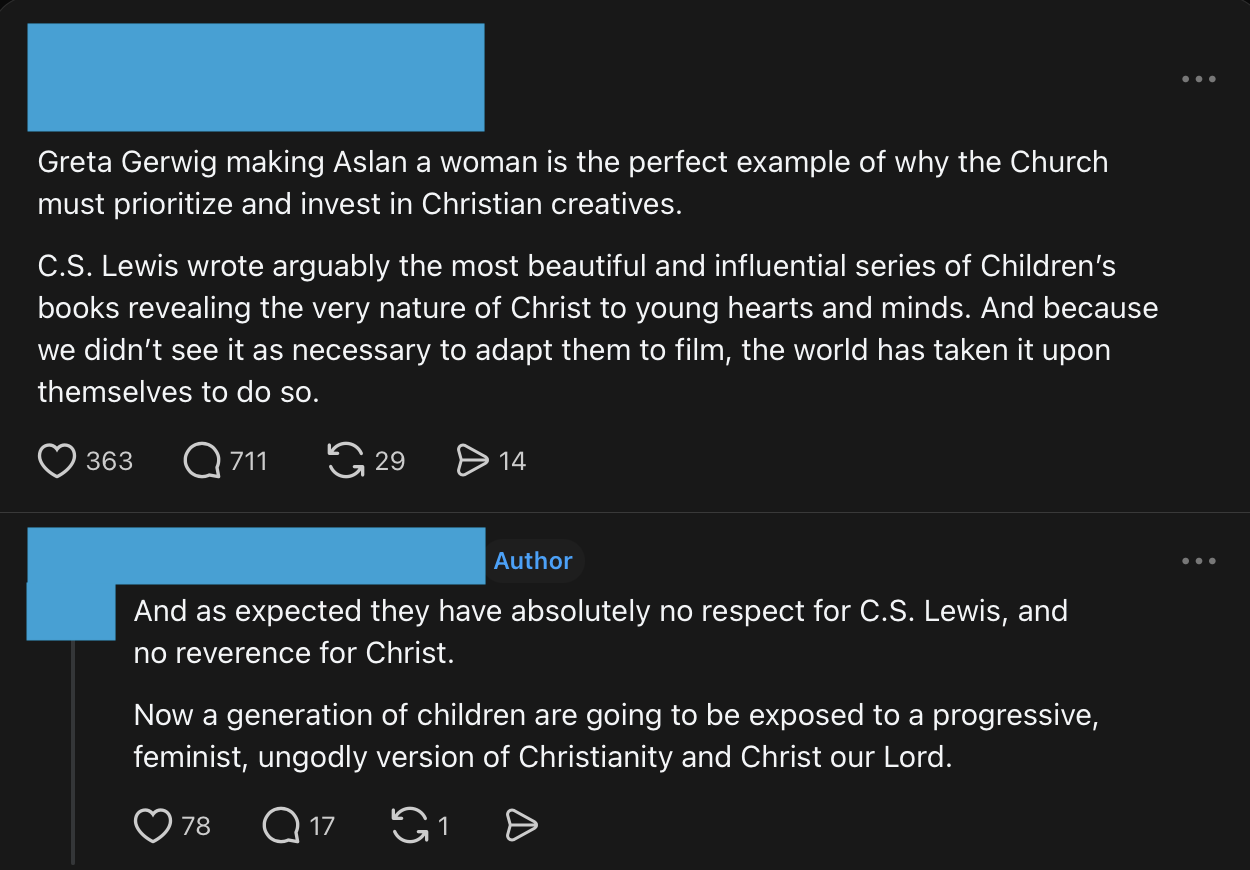
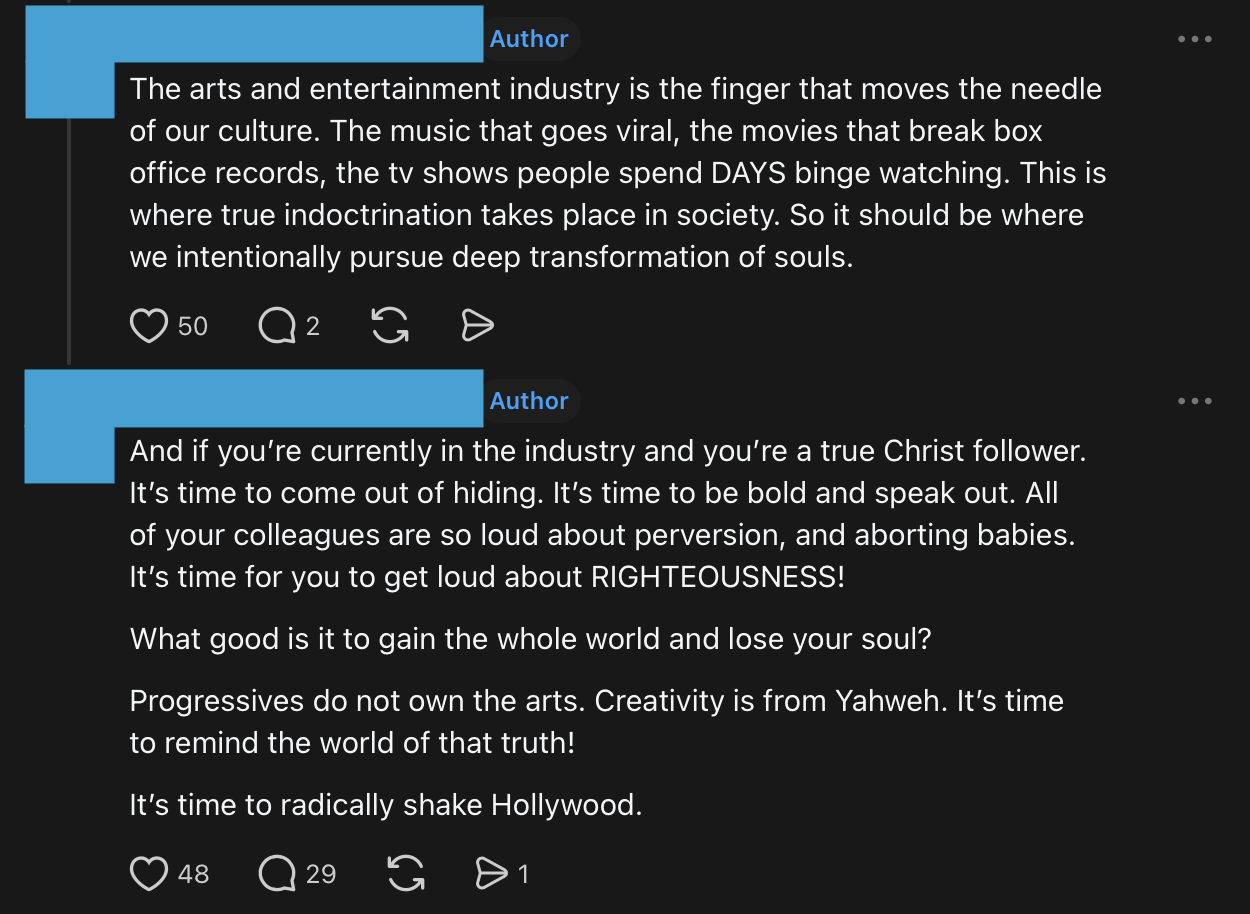
Language such as this is common in today’s acceptable religion. In this telling, human creation and art are only good as a means of cultural capture and political control. Community is not where minds and hearts or changed; the seizing of power is. But when a person creates in this mindset, they become guilty of doing the very things they accuse the culture of: trying to indoctrinate, disrespecting original sources, and claiming they have complex moral and social situations all figured out. If the ends justify the means, then the means can be whatever you want them to be.
This explains why such churches usually don’t support storytellers and artists in public spaces and, when they try to, it almost always goes very poorly. This approach immediately, vastly shrinks the pool of talented artists and storytellers willing to work with you, including ones who are sincere Christians, because good creatives know the result will be propaganda, not good storytelling. Those willing to work with such churches usually end up just promoting the church paying them —not creating anything that benefits neighbors or society— because churches seeking to use creation and art for specific self-beneficial ends are, by nature, inward looking. It’s not that enchantment becomes a secondary goal; it’s that the very concept of enchantment is completely absent.
All of this drives the culture —the very thing such Christians claim they want to reach and change— further away from themselves. Why? We live in a world that no longer needs the watered-down view of God that this subculture offers. The one that shrinks God into an idol so small and weak it fits in your pocket and can be used to try to exert control over others. From my last post this one is building on:
“Since the Enlightenment, if not earlier, there has been an unhelpful tendency in large swaths of Protestant Christianity to believe that our growing intellectual tools can be used to capture the full essence of God and nail down every detail of how salvation works. Increasingly that feels like a fool’s errand, one made more apparent by the rampant religious disenchantment spreading around us.
As humankind has made significant material progress, albeit very unevenly and unfairly, the truth is that the world needs the God of acceptable religion much less than it once did. Science and other academic traditions now ask and answer questions humans once attributed to higher spiritual powers. In response, evangelicals —some of whom, long ago, were imperfect but admirable champions of social progress that benefited the masses— have largely withdrawn from such efforts and doubled down on an understanding of religion and salvation that attempts to legitimize who they want God to be in every day life: an authoritarian who will assuage their anxieties by recentering them in American society. Ironically, the end result functionally places God as Ultimate Reality outside their own modern understanding of reality.
For a time salvation became more exclusively about saving souls and getting to Heaven in a world considered beyond redemption. The situation has worsened much further today. Acceptable religion is now chiefly known not for bringing souls to the Cross but gleefully nailing neighbors to metaphorical crosses and, increasingly, modern versions of real-world crosses. Idolatry to religious culture and political power are the new Golden Calf.”
Put another way: a lot of sincere Christians have simply grown up and out of acceptable religion. Most churches in this vein haven't, and because they haven’t they offer little by way of beauty, relevance, or true community to daily life. This idea that Jesus is relying on us to put him at the center of the world through culture warring via creative potential is laughable from biblical and historical perspectives. If the Resurrection is true, Christ is already at the center of the world and Lord of All. Behaving otherwise is a telltale sign one doesn’t recognize the Resurrected Christ. Again:
“If Christianity is rooted in historical events as so many evangelicals claim it is –something I happen to agree with, although likely in a different mode— then Christianity as a religion is subject to the same historical forces all religions are, whether we like it or not.
Christianity is not holy because we call it holy. It is not unique because we say it is unique. Christ is not at the center of our religion just because we mindlessly say he is. No acceptable religion of the day is above critique, especially historical and Scriptural critique. Indeed, if Christ is already at the center of the world and already redeeming it, then the Jesus story is the first to call our religion into question. Religion does not escape the judgement, perhaps even the redemption, of the Risen Savior.”
If Jesus truly is Lord of All, if this really is the Ultimate Reality, then the Christ event brings us to an even more important question.
Can “truth” produce beauty? Can it enchant?
The Church should invest in creative storytellers and artists, although not at all for the reasons acceptable religion provides. I’ve come to realize this is one of my primary beefs with acceptable religion, at least on a personal level, as storytelling and creative work has been a central part of my life for over 15 years. In my experience, most people in acceptable religion neither respect the process of storytelling nor appreciate beauty, despite the historic Christian faith and the Church being built on both.
As I mentioned earlier, this kind of subculture almost always sees artistic beauty and story as means to something else, not as ends unto themselves that truth then flows from. But that stems from an even deeper problem: those in the fold of acceptable religion see beauty in general as strictly utilitarian, which can be deeply harmful.
This is why a woman can't simply exist as beautiful in white evangelical spaces. Her beauty must have utility, leading men to hyper-sexualize her, which is a degradation of the truth of who she is. Marriage is believed to only be right and beautiful if the man is in charge, while a healthy marriage between a man and woman who love each other as true equals and adore Jesus is judged as inferior, problematic, and —ironically— not biblical. It’s why the current American regime, of which this church subculture is its main backer, is openly assaulting pathways for human thriving and those who desire to go into the arts. And yes, a film adaptation of a story that the author said is not an allegory can only be good or true if it speaks to the exactness of the allegory we demand it be.
There are many reasons people are becoming disenchanted in these kinds of churches. One is that truth by its very nature cannot enchant. Beauty can, but when the view of beauty has been degraded into a mere tool for some other end it has lost its power to captivate. The Psalmist writes in 27:4 “One thing I asked of the Lord; this I seek: to live in the house of the Lord all the days of my life, to behold the beauty of the Lord, and to inquire in his temple.” One is not hard pressed to notice beholding beauty in the house of the Lord comes before any form of inquiry or search for truth. In the presence of the Ultimate Beauty, the Psalmist assumes truth will be secondary to beauty and flow from it, not the other way around.
This is why actually reading Lewis and Tolkien —who deeply influenced Lewis— can be so helpful. Not just their stories, but also their letters, lectures, and essays in the contexts they were crafted. Both men created their myths and stories for many reasons, one being an abiding joy, love, and admiration of the Creator and their fellow man. So they sub-created, making things in a derivative mode in recognition that we ourselves are made in the image of the Creator. God did much of this out of chaos and nothingness. We can do this in a much more limited way in our own world. The result, when this is done not for allegory but out of deep love for the Creator, is a kind of deep beauty that transcends time itself.
It should come as no surprise then that the culture has been slowly turning away from this form of the Church for decades. Increasingly, acceptable religion offers neither relevance to daily life nor a beautiful story to enchant you. This stems from the core misbelief that real beauty can only stem from truth. It’s the opposite. Truth, indeed reality itself, is a mere extension of The Ultimate Beauty shrouded in the mists of myth. C.S. Lewis speaks to this in his essay Myth Became Fact, which I find myself sharing a lot these days:
“When we translate we get abstraction-or rather, dozens of abstractions. What flows into you from the myth is not truth but reality (truth is always about something, but reality is that about which truth is), and, therefore, every myth becomes the father of innumerable truths on the abstract level. Myth is the mountain whence all the different streams arise which become truths down here in the valley; in hac valle abstractionist. Or, if you prefer, myth is the isthmus which connects the peninsular world of thought with that vast continent we really belong to. It is not, like truth, abstract; nor is it, like direct experience, bound to the particular.
Now as myth transcends thought, incarnation transcends myth. The heart of Christianity is a myth which is also a fact. The old myth of the dying god, without ceasing to be myth, comes down from the heaven of legend and imagination to the earth of history. It happens-at a particular date, in a particular place, followed by definable historical consequences. We pass from a Balder or an Osiris, dying nobody knows when or where, to a historical person crucified (it is all in order) under Pontius Pilate. By becoming fact it does not cease to be myth: that is the miracle. I suspect that men have sometimes derived more spiritual sustenance from myths they did not believe than from the religion they professed. To be truly Christian we must both assent to the historical fact and also receive the myth (fact though it has become) with the same imaginative embrace which we accord to all myths. The one is hardly more necessary than the other…
We must not be ashamed of the mythical radiance resting on our theology. We must not be nervous about ‘parallels’ and ‘pagan Christs’: they ought to be there-it would be a stumbling block if they weren't. We must not, in false spirituality, withhold our imaginative welcome. If God chooses to be mythopoeic -and is not the sky itself a myth- shall we refuse to be mythopathic? For this is the marriage of heaven and earth: perfect myth and perfect fact: claiming not only our love and our obedience, but also our wonder and delight, addressed to the savage, the child, and the poet in each one of us no less than to the moralist, the scholar, and the philosopher.”
Truth can only produce the illusion of beauty. Or maybe it’s better to say that since truth is about something else it can, at best, point back to a glimmer of mythic beauty. Truth can be a stepping stone to the mythical radiance Lewis describes, but truth is not the destination. Beauty is. Sub-creating beauty for beauty’s sake, then, is one of the most Christian things a person can do. It explains why Lewis and Tolkien's works are more popular than ever, including with people who don’t consider themselves Christian, and with Christians who don’t understand any of this at all.
Sadly, the church subculture we are examining has zero interest in understanding sub-creation in its biblical, historical, and literary forms, because the view of God is a degraded one that is a mere reflection of what people see in the mirror: their own aspirations, fears, and desires. Those clinging to the sinking ship of acceptable religion are convinced they have special access to truth, therefore they believe they have a monopoly on beauty. That’s not how any of this works, at all, but it does explain why discipleship is such a disaster in this kind of church subculture, and why formation is hardly given any attention. And it’s why so few people outside this subculture find anything beautiful at all about white evangelicalism, fundamentalism, or whatever other word we want to use to describe acceptable religion.
Approaching beauty
How would this understanding that truth stems from beauty, not the other way around, change how we read Scripture? How we worship? How would it change our behavior and language? What would it change in our understanding of atonement? How would it change our churches, or even acceptable religion itself?
There are too many ways to count, but a few examples come to mind.
We will recognize in the Creation myth that Adam is not the crown jewel of Creation. Eve is. Considering so much of today’s acceptable religion is male-dominated and engaged in open phallus-worship, this recovery of beauty has massive theological implications that offers hope and healing to a fractured, and frankly misogynistic, church subculture. It will be much easier to see that phrases like the centrality of the Cross is a tool used to ignore the Savior who was nailed to it. Words we use to describe God —omniscience, omnipotence, love, wrath…whatever— suddenly pale in comparison to the full beauty of who God actually is. Indeed, we will begin to see it is the powerlessness of God found in Christ that saves us, because this God chose to identify with us in our own suffering, harms, and brokenness. The apostle Paul writes in Philippians 2:
“Let the same mind be in you that was in Christ Jesus, who, though he existed in the form of God, did not regard equality with God as something to be grasped, but emptied himself, taking the form of a slave, assuming human likeness. And being found in appearance as a human, he humbled himself and became obedient to the point of death—even death on a cross.
Therefore God exalted him even more highly and gave him the name that is above every other name, so that at the name given to Jesus every knee should bend, in heaven and on earth and under the earth, and every tongue should confess that Jesus Christ is Lord, to the glory of God the Father.”
We have only scratched the surface, but this is all profoundly compelling and beautiful, especially in the face of an acceptable religion —one that is drunk on power and false notions of its own grandeur— that offers so few answers to a world it refuses to see Christ at the center of. But when we do see Christ is already Lord of All, we no longer feel as if we have to be.
Returning to Narnia, much of the “Christian” outrage over Gerwig’s upcoming film adaptation of The Magician’s Nephew seems to stem from the insatiable desire of those inside acceptable religion to see themselves and their beliefs, not Jesus, at the center of the world.
Many folks who identify with acceptable religion are saying out loud that they can’t see the forest for the trees. They can’t get past one thing, that a fictional character is being voiced by a woman, and are blind to the bigger picture as a result. It is entirely possible that this movie ends up being bad; but, if it is bad, it won’t be for the reasons such people think.
When I first saw this image of Aslan creating Narnia in The Magician's Nephew adaptation, I was simply struck with how beautiful and mythic it is. I began to glimpse the innumerable truths that Lewis alludes to in the above essay. It brings to mind the hinge point between the two different creation myth accounts in Genesis 1-2. That this is one of the first images released is a good sign that Gerwig is onto something big. She is, after all, one of the most talented directors of our time.
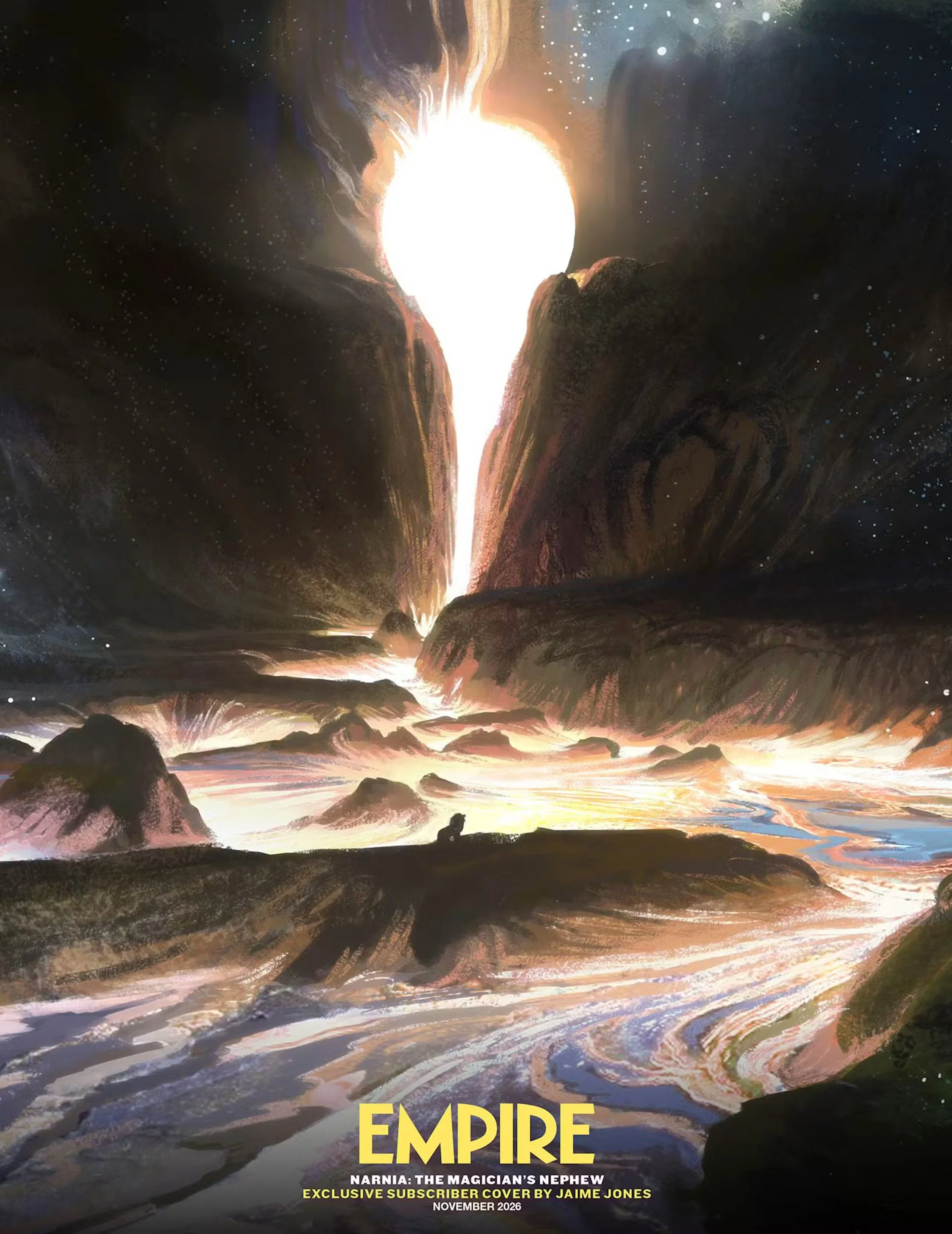
Covert art provided to Empire Magazine. Click or tap to expand.
Sadly, because acceptable religion has done a disservice to so many people by murdering the Christian imagination, many in that fold seem likely to miss out on the deeper themes the film will likely point to. We can always find things to complain about in our favorite stories and in art more generally. Nothing we create will be perfect —and yes, some human creations turn on out to be objectively bad— but trying to hyper-control the outcome of an artist’s creative process isn’t so different from trying to control God, just like it isn’t so different when we insist Lewis’ work is an allegory even though he said it wasn’t. We look foolish when we behave in such unhelpful ways, so we should stop doing it.
Closing Thoughts
If the Church —at least as described by acceptable religion— is going to support creatives and artists in healthy and helpful ways, the people inside it can only begin to do so by recognizing that beauty alone is more than enough to allow us to feel the brushstrokes of truth. To do that would require an end to acceptable religion, which seems unlikely to happen. It is much easier to cling to notions of what is pure and impure, and lie to ourselves that we’re capable of playing judge, jury, and executioner in a world exhausted by death and judgement. This is true regardless of whether we’re talking about a film adaptation or matters of life and death. Indeed, this church subculture seems to always confuse the two in its relentless culture warring.
We live in a moment when the world’s cries for beauty ring ever louder. All acceptable religion has to offer is, at best, a loveless and vacant truth. As Paul writes in 1 Corinthians 13:
“If I speak in the tongues of humans and of angels but do not have love, I am a noisy gong or a clanging cymbal. And if I have prophetic powers and understand all mysteries and all knowledge and if I have all faith so as to remove mountains but do not have love, I am nothing. If I give away all my possessions and if I hand over my body so that I may boast but do not have love, I gain nothing.”
Translation: truth doesn’t matter if it isn’t rooted in love. As the best truth stems from The Ultimate Beauty and love is beautiful, the truth so many say must be boldly proclaimed may not even be true, as it is missing both the beauty and love of God. Because beauty is the point. We should embrace beauty and enjoy it as we were offered in the mythic Garden, and in doing so we may be surprised that we stumble into deeper truths along the way.
When we do so, it becomes apparent that those inside the shrinking walls of acceptable religion have much more to learn from today's creators and artists -who are out in the world where the Risen Savior already is— than it does to criticize from inside an ever-shrinking bubble of people, influence, and resentment. A bubble that is shrinking by its own refusal to mimic The Creator or try to be like Jesus, who offers a better way: the Beautiful Way.

About Me
I explore faith, church culture, and formation in the American South from my hometown of Memphis, TN. I often feel as if I don’t fit into the dominant church culture around me. Everything here is an expression of my faith and love for the Church as I try to figure this Jesus thing out.
Never miss an article by signing up for my newsletter and subscribing to the podcast. You can also become a member or leave a tip to help keep everything free and open to all.