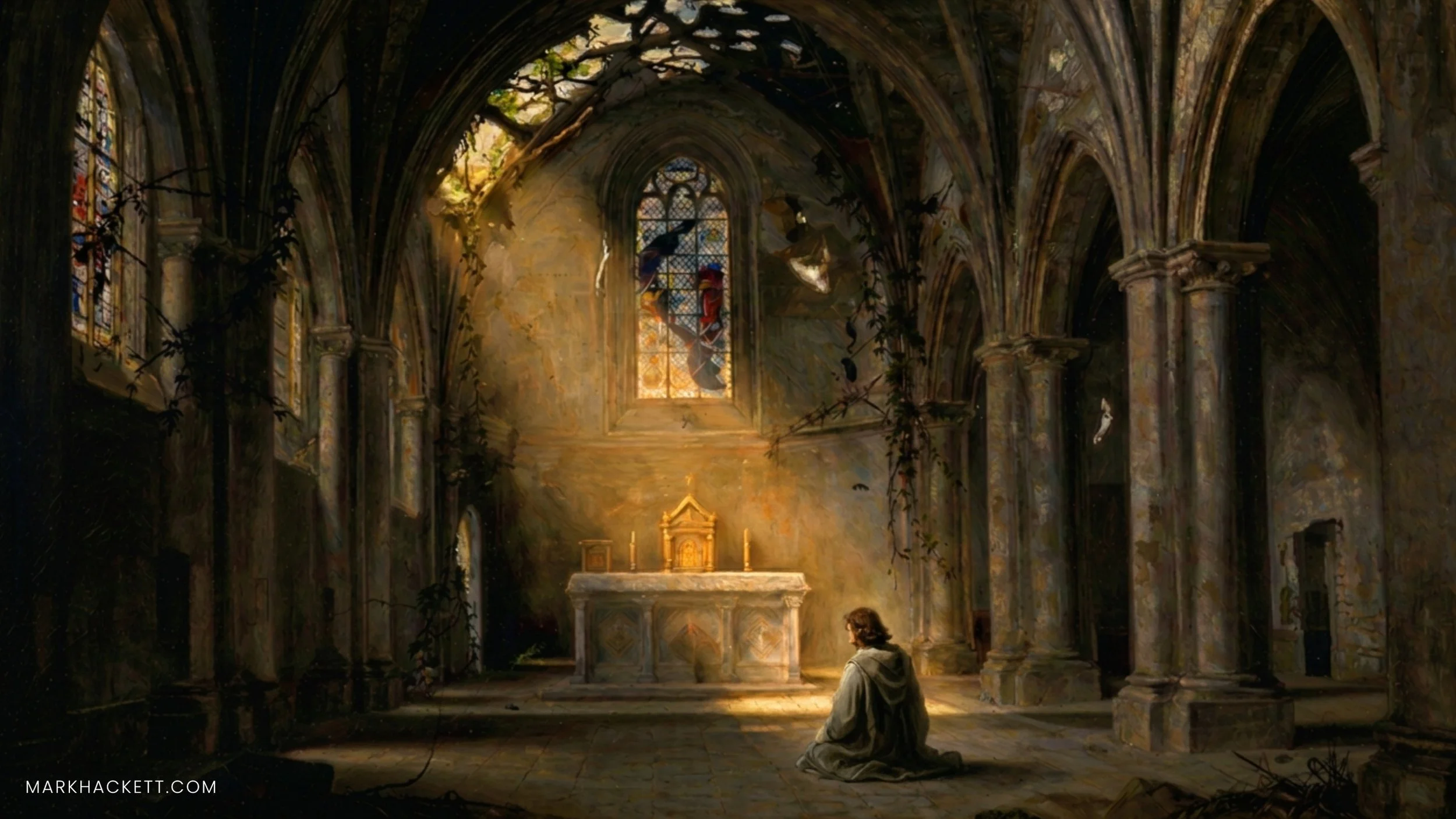
“History has brought us to the point where the Christian message is thought to be essentially concerned only with how to deal with sin: with wrongdoing or wrong-being and its effects. Life, our actual existence, is not included in what is now presented as the heart of the Christian message, or it is included only marginally.”
- Dallas Willard, The Divine Conspiracy
•••••
Recently I found myself in a room that was a lot more fundamentalist than I was prepared for. The waves of extreme certainty about everything, endless harping on the depravity of the world, and language of cultural domination drowned out the stated purpose of the gathering. It had been several years since I experienced all of this so directly on a larger scale. Eventually I was able to get my bearings and remind myself this is part of my past, not my present story, just like it is for so many others.
That gave me the space to observe. Some things said made me cringe. A few moments were thoughtful and interesting. Most of it though boiled down to run-of-the-mill virtue signaling, the fodder for much of America’s erratic energy today. But as the minutes ticked by I mostly started feeling how off-putting it all was. Terms such as biblical and The Gospel made multiple appearances, but the cosmic hope we see in Scripture was glaringly absent from this very white evangelical room.
The mild anxiety I was feeling suddenly gave way to something I did not expect: sadness. The room suddenly felt very small. As things began to wind down, a thought I’ve had many times the last several years popped into my head: this feels out of touch with my daily life and God’s promise to make all things new.
Like most subcultures, the white American evangelical one is complicated. Contradictions are everywhere but consistency does exist. There are moments that are beautiful and others that are downright horrifying. Sometimes truth emerges and is embraced in surprising ways. Other times truth smacks people in the face but they remain blind to it. There is a loyalty that leads people to helping one another in profound ways, but too often that desire to help ends inside white evangelical borders.
Still, over the last decade and as this subculture has arrived more fully at its logical conclusion, something seems to have shifted. The first part of Dallas Willard’s critique above has been the story of this kind of fundamentalism for decades. For a time, for whatever reason, a lot of people genuinely seemed to relate to a message that was mostly about sin management. But now the second part can be felt more acutely; indeed, it’s what I felt sitting in that room: “Life, our actual existence, is not included in what is now presented as the heart of the Christian message…”
Regardless of whether one thinks the non-stop changes in our country since 9/11 are good or bad, evangelicals have been impacted by immense social pressures like all of us have. At some point over the last ten years most of us have thought I didn’t ask for any of this regardless of our backgrounds, hopes, beliefs, and concerns. Some evangelicals have been softened by the last 25 years, while others have hardened even more.
Yet people are still leaving churches, especially younger generations and women. This month I want to examine what I think is one of the lesser-discussed reasons that drives some people away. Namely that a specific approach to the core theology underpinning this subculture —penal substitutionary atonement— makes one feel as I felt sitting in that room: this just doesn’t feel relevant to daily life.
I’m not interested in arguing whether PSA is right or wrong or the full picture or not. What I’m after is addressing this much more practical problem of why PSA can be disenchanting for at least some of the folks we see who walking away from churches.
A hill to die on?
Before continuing we should try to define Penal Substitutionary Atonement (PSA). That’s not easy to do. For starters, while many people are familiar with the language and core concept of PSA, a lot of folks don’t know the technical term for it. More importantly, PSA is a bit like mint chocolate chip ice cream: lots of brands make it and some are better or worse than others. Too much or little of one ingredient, or low quality ones, wrecks the taste and mouthfeel. I obviously have strong opinions about ice cream, but I digress.
It is more useful for our purposes though to define PSA as it is often treated in the church subculture I described above. The scope quickly narrows and goes something like this: individuals are guilty of sin and this has separated us from God. We are born into sin and are not capable of bridging the divide. We are threatened by God’s wrath as a result. We need a savior from God’s wrath, so God provided His son Jesus and punished him in our place. Believing Jesus replaced what should have been me on the cross means I am saved.
This is not the only interpretation of PSA; I am merely describing how it is often pitched from pulpits and in bible studies here in Tennessee. There are healthier versions emphasizing God’s holiness and love instead of wrath. Regardless, one the core features of this approach to PSA is how ferociously it is defended. For those in the pews this is mostly due to the insularity of white evangelicalism. This harsher style of PSA is equated as being “The Gospel” to such an extreme degree that some are unaware different theories of atonement and understandings of God exist. Others look down on the ones they have heard of, usually due to something specific they don’t like in another Christian tradition, without knowing much about that tradition to begin with.
This can become especially ugly in swaths of the pastoral class and in the upper echelons of evangelical consumer culture. I’ve lost count of the number of times I’ve heard a pastor or other church leader rail against “Catholics’ works-based righteousness”, a phrase that usually hints at some ignorance of what day-to-day life is like in the Roman Catholic tradition. John Piper’s outfit Desiring God —undeniably representative of much of the white evangelical fold— has even declared penal substitution as “the hill we all must die on.” Even if PSA is true, that seems…extreme.

Whether by insularity, ignorance, or narrow-mindedness, this certainty around PSA and “what the Bible says” has plenty of negative consequences, from restricting what is allowed in biblical interpretation to equating brokenness and finiteness with sin and evil, from individualizing all sin to rejecting the fact that sin can be systemic, to confusing painful and unjust ancient cultural practices with “being biblical.” This extreme certainty around PSA bleeds into certainty about so many other things we should have questions and reverence for instead.
Disenchantment with cultural PSA
Much attention is paid to the number of people leaving evangelical spaces and citing direct harm as their reason why. I don’t want to diminish those stories; that’s part of my story. And I know from experience questioning certain elements of PSA or the culture built around it can lead to one’s integrity being questioned, or even harm being done.
Becoming disenchanted doesn’t always begin with destructive words and actions though. In fact, the opposite may be more of the case. Research presented in The Great DeChurching suggests a majority of people who have stopped attending church do so for mundane reasons, such as moving to a new city, having other things to do on Sunday, or a change in family status. The data presented seems to raise more questions than provide answers; however, considering Ryan Burge —arguably one of the top religious statisticians in the country— was involved in the project and the authors feature gentler evangelical names, what they present should be taken seriously.
So why is it that when people, say, move to a new city they don’t try to find a new church? The authors note some are willing to return and just need to be invited. Fair enough. But what about those who aren’t willing to return and haven’t been harmed either? What are their grounds for not going back? Reasons abound and the authors provide some that are familiar, which include things like a poor witness in their parents (i.e. culture warring), political disagreement, and more.
I’m not convinced that’s where the story ends though. Perhaps this is because of where I live, and this is entirely anecdotal, but the people who drifted away from church are who I tend to see the most disenchantment in with this style of PSA and the brittle culture of certainty around it. I’ve met plenty of folks who just…stopped going to church and have no plans to return. They didn’t move to a new city. Their family status didn’t change. No harm was done to them. Maybe they had a disagreement or a concern, but it’s one they had lived with for years with no issue.
In discussing why they left and aren’t going back, the responses I get are mostly shrugs and mehs. Both are telltale signs of some kind of disenchantment. Push a little further and you definitely start hearing answers like the ones above, which can be signs of disenchantment, too.
But I also hear an answer similar to what I was feeling in that room. Even when the language is softer and politics is put aside, a lot of what is being said in sermons, Bible studies, and more about God and the nature of atonement is just hard to connect with. It often doesn’t feel relevant to daily life or makes God feel two-dimensional. I’ve met quite a few folks who fit this description and still consider themselves followers of Jesus, but over time they still drifted away from a church.
Understanding disenchantment as a process
It’s difficult to over-emphasize the frustration and anxiety white evangelicals get when PSA or its surrounding culture is brought into question. This seems to be where the seeds for some of the disenchantment we see today are sown. There is an unhealthy certainty, even an extreme one, that more or less says its PSA or the highway. This specific evangelical anxiety can show up in all kinds of ways, perhaps most noticeably when someone merely suggests the story of Jesus is about more than one’s personal sin. Sometimes I have even wondered if the issue is not with PSA as a theory so much as it is with how PSA gets idolized over and above the God-man the theory is trying to understand.
That is fragile ground to stand on, which becomes apparent when harm is done or an urgent problem emerges that has no immediate solution. If you have been taught that the Christian faith is PSA or the highway, that the most important things are already figured out and you just need to accept them, and suddenly the people who made you believe that go off the rails, it’s no surprise someone would walk away. If this is “the best” or “most true” version of the Christian faith —a vibe many evangelicals exude in both word and deed— and this is how it ended, why would someone want to return? Disenchantment, predictably, becomes fast-tracked.
Going back to our question about those who slowly drift away though, the ones with the shrugs and mehs as their reasons for leaving, disenchantment is more of an extended process. It can begin in many places, but what is said in pulpits on Sunday mornings can be the easiest to spot some of these seeds. To provide just one representative example, several years ago a well-known, very mainstream evangelical leader gave a sermon entitled “The Kingdom of God Is Not Good News” that is a fair representation of how PSA is often presented in spaces like these. Here are two excerpts:
“Yes, Jesus reigns. Yes, the King and the kingdom have come. But, no, that is not good news. I get frankly very tired of people building their theologies around that as good news. It’s not — not without blood, and his in particular. Not without substitution. There is no good news in the resurrection of Jesus. I’m going to be slaughtered by this deathless king. No good news in his reign. No good news in his coming. Not until he becomes a bloody Savior do I feel any hope at all before the reign of God Almighty…
And now, for all of us who are in Christ, the wrath of God is spent and justice is satisfied and what makes that good news is that when he died, he bought for his own faith in Jesus Christ, resurrection from spiritual death, eternal life, forgiveness of sins, justification, or the imputation of his own righteousness, peace with God, escape from hell, and the enjoyment of all the new covenant promises, the best and highest of which is, ‘I will be your God, and I will be with you, and you will be my people.’”
This is shot through with PSA buzzwords, and language akin to this is common in churches. A few such seeds for disenchantment here are obvious. The first part makes God sound like a tyrant and blatantly ignores the life of Jesus. The language of sacrifice in the second part reduces God to an equation that needs to be solved. It’s over-intellectualized to the point of being incomprehensible. We are told the Gospel —the literal Good News— is “no good news.”
Here are what may be the less obvious seeds of disenchantment though. There’s a lot in here about wrath, slaughter, bloodshed, and substitution. I’m willing to bet most of us have not seen an animal be ritually sacrificed. I certainly hope none of us have watched a fellow human be crucified. It is so difficult to connect with this kind of extreme violence because we don’t hear the agonizing cries or smell the stench of sweat and blood. We can try to imagine such suffering or look at art that depicts it, but that barely gets us anywhere. I am grateful virtually none of us ever experience violence like this, as we all should be.
This language is also worshipful of violence itself though. That can be a hard enough pill to swallow for modern people who are entering a postmodern era, but it also doesn’t jive with the teachings and story of Jesus, who called his followers to turn the other cheek, aid the sick and needy, and meet people where they are. These are all things Jesus did himself. Nowhere does Jesus point to the violence unleashed on him and say This is my way, now worship it. He does say a lot about following the relational examples he sets though. Worshipping the violence of the cross instead of the One nailed to it, following the violence of imperial Rome instead of the Risen Savior; both lead people into being far too comfortable with the violence we see in our own times.
Finally, the Cross presented in this over-intellectualized and formulaic way through the lens of what it does just for the individual is out of touch with our daily lived experience as humans. It doesn’t have answers for the damage in the world we see around us. It’s not rooted in Creation. It’s not relational. It feels detached from history. Indeed, it quite literally casts aside the majority of the Jesus story.
When people hear messages like this month after month and year after year, when folks are reading their bibles and taking it seriously as they’ve been told to do, when people see our country in political crisis and basic needs exploding all around them, the disconnection between what is taught as true and the complexity of Scripture and the realities of daily life begin to be felt more acutely. Disenchantment is bound to set in because this interpretation of PSA and the resulting cultural expression of it feels irrelevant when it starts coming into contact with the real world. And I don’t think it’s a stretch to think it will become even more difficult to connect with as the post-war era continues coming to an end.
To summarize, overzealous certainty plants the seeds for disenchantment, but overzealous certainty disconnected from lived experience spreads disenchantment like wildfire. Salvation is not a math formula to be worked out. Life is too hard for the most important things to be so easy. Yes, people leave churches because they were hurt or let down. Some drift away for mundane reasons. But some also depart because what is being taught as absolute truth and the lack of just action stemming from such teaching doesn’t have answers for their daily life or the world around them.
Closing Thoughts
The primary reason I’ve become disenchanted with Penal Substitutionary Atonement is because of the poor and shallow culture it has produced around me. I say this while knowing people who take a healthier approach to PSA, emphasizing God’s love or holiness instead of wrath. I know people who fit PSA into the larger array of atonement theories sincere Christians around the world have long held onto, even if they don’t always know the technical language. I don’t find it surprising that pretty much all of these people behave in ways that are more Christlike. They are living proof that having some sense of mystery instead of certainty is the path to becoming enchanted with God and discovering the joy in loving neighbors.
But far too often such people get drowned out by the extreme certainty of the PSA or the highway types. We know why this is the case. When a whole theological framework is wrapped up glorifying images of violence, slaughter, sin, and wrath the odds of people dehumanizing and writing off violence inflicted on others goes up, sharply. Apologetics is all about winning. Defensiveness becomes the default position. Worshipping a theory about God replaces worship of God. Belief affects action, and action affects belief. It’s all a vicious cycle.
What we must also pay attention to though is that when salvation becomes a spiritual-only transaction that is treated as if it took place outside of history, and if the stated benefits of that transaction only apply to personal sin and nothing more, then theology inevitably becomes divorced from lived experience. Eventually it will detach people from their own stated ethical commitments as the culture produced becomes an idol. Oppression goes unchallenged; indeed, Jesus not openly resisting his own execution becomes a brutal tool wielded to force victims of oppression to accept the damage done to them. This subculture becomes another form of the very oppression it claims to be opposed to. It becomes Empire, even Mammon. The evidence is all around us today.
I’m aware there are thoughtful and kind evangelical bible scholars and theologians who have ready answers for concerns like these, and may even share a few of my concerns as well. Again though, I’m not arguing whether PSA is right or wrong or biblical or not. My concern is that more holistic views of PSA and what atonement means for daily life that can be found in some seminaries and other Protestant traditions seem to be absent from a lot of local churches here where I live. My concern is that this is one source of the really bad fruit we are seeing today. It gives people one more reason to walk away without considering there are older and healthier ways to try to follow Jesus and live in community with others.
It is saddening to think that in countless churches this is how faith is being taught and lived out, and it is frightening how convenient and small this form of PSA makes God out to be. The Creator is reduced to being an intellectual theory, a little idol we place neatly in our pocket and pull out anytime we want more control. It is all done in earnest. The disenchanted who leave this subculture behind, by harm or by feelings of irrelevancy, do so because, in the words of C.S. Lewis: “I’d sooner live among people who don't cheat at cards than among people who are earnest about not cheating at cards.”
As harsh as that sounds, and despite my being outside fundamentalist spaces long enough for it to feel jarring to be back in one, I have empathy for folks in such churches. I am human just as much as they are. I used to call this subculture home and didn’t think twice about it. And it is too easy for all of us to think the time we inhabit is unusually perilous. We all have blind spots and we Americans often lack historical perspective. Without the lessons of history, the present day will always feel more immediate, loud, and scary. Without history, we arrive at the bizarre place of believing the Gospel is “no good news.”
In history we see that churches have gone off the rails before. We can see what was done and asked of God to bring people back into His Kingdom. We can see that other Christian traditions exist for many reasons, including for times such as these, to help provide correction to their cousin traditions and serve as a safe harbor for those in need of rest, repentance, and repair. And in those traditions we can see there is a way to account for sin that produces better, and dare I say more attractive, fruits.
In a time of conspiracy theory, post-truth fears, and extreme certainty run amok, honesty and authenticity matter all the more. So does meeting people where they are, not where we wish them to be. These times require us to examine the fruits of our beliefs and use that to judge just how good or bad our beliefs really are (Matthew 7:15-20). And yes, it requires us to ask who God really is, not who we wish him to be. When we do that, we discover there are tangible ways to better understand and follow Jesus today that are sorely needed.
Somewhere along the way we may just find ourselves becoming enchanted with the Risen Savior. The Cross was neither the beginning nor the end of the story the God of the universe invited us into. It’s a story that is still being written today, a story of this world slowly, painfully trying to find its way back to the enchantment it was born in.

About Me
I explore faith, church culture, and formation in the American South from my hometown of Memphis, TN. I’m an institutionalist who believes the means are just as important as the ends. Everything on this site is an expression of my faith and love for the Church.
Never miss an article by signing up for my newsletter and subscribing to the podcast. You can also become a member or leave a tip to help keep everything free and open to all.