Mourning, the making of history, and Tolkien’s eucatastrophe

"Stories –frankly, human stories are always about one thing– death. The inevitability of death."
- J.R.R. Tolkien, The BBC in 1968
•••••
I’ve been thinking about mourning a lot the past several months, specifically what the social utility of the practice is and what role mourning plays in the human story. Mourning doesn’t feel natural to a lot of us Americans, including me. It’s not that we don’t get sad or upset; we do. There’s just a strong tendency to stuff those emotions down instead of following them into what is probably a needed process.
Death found in the passing of a loved one, the last day of a job we enjoyed, or the end of a reality that was never fully true…death in all forms is a strange thing. Recently while reading in James 4 with some friends, we came across this passage that started connecting a few dots for me about mourning:
“Lament and mourn and weep. Let your laughter be turned into mourning and your joy into dejection. Humble yourselves before the Lord, and he will exalt you.”
As a bad Protestant living in the American South, James can already feel difficult. The Protestant Reformation provided the world many good things but was far from perfect. One poor fruit is this awkwardness around James. Luther’s treatment of the letter has led to centuries of tension, annoyance, and even ignoring James. This specific passage is a great example. On surface level the thought of God exalting humans doesn’t sit well with a lot of people like me. We’ll circle back to this at the end; but, for now, I don’t think James was talking about exaltation where we find ourselves, but making an eschatological connection instead.
I started thinking about the role of mourning last summer during a reread of The Silmarillion, the book containing the history and myths of Middle Earth that precede The Hobbit and The Lord of the Rings. One reason I’m a fan of J.R.R. Tolkien is that he didn't shy away from death and mourning in his stories. Today is Tolkien Reading Day and, with this year’s theme being “Unlikely Heroes”, now seems an appropriate time to take a swing at whatever this connection between mourning and the making of history is. Middle-earth is full of many unlikely heroes besides hobbits who can be easy to miss.
Before we begin though, I’d be remiss if I didn’t mention Tolkien was adamant his work was not allegory. From the foreword to the The Lord of the Rings:
“I cordially dislike allegory in all its manifestations, and always have done so since I grew old and wary enough to detect its presence. I much prefer history –true or feigned– with its varied applicability to the thought and experience of readers. I think that many confuse applicability with allegory, but the one resides in the freedom of the reader, and the other in the purposed domination of the author.”
Muddying the waters between allegory and applicability for people like me —I’m not a trained literary critic— is that, in our moment on the historical timeline, it feels there is too much to mourn. A decadent materialism often shackles our imagination. It is far too easy to believe voices we respect are explaining what we are experiencing and telling us what we should do, even when they’re not. For these reasons, applying what Tolkien called the secondary world to our primary world, even though I think that is allowed and useful (see Tolkien On Fairy Stories), feels uncomfortable to me. But my goal is to respect Tolkien’s belief that his work is not allegorical while using the “freedom of the reader” to draw guidance from his stories and hopefully arrive at a few of my own conclusions about the designs and purposes of mourning.
A final note before jumping in: while what follows is for anyone, some of it may be harder to track if you haven’t read The Silmarillion. Some regular readers share my love of Tolkien, others have only seen the Jackson/Walsh films or are completely unfamiliar with Tolkien’s works. You may be new here. You may not be a Christian. There’s a good chance you are more knowledgeable about Tolkien or Scripture than I am.
Like a lot of Tolkien fans I believe his stories are for everyone. In that spirit, what follows is best viewed as introductory and exploratory, not authoritative. Many finer details have been left out so those who are less familiar can follow along. Regardless of who you are though, “Elen síla lúmenn’ omentielvo!”
In the beginning, there was grief and mourning
As I was rereading The Silmarillion last summer, something jumped out I had never noticed. From page 28 in the Valaquenta, the description of the divine spirits the Valar who inhabit the World that Ilúvatar, the Creator, made:
“Mightier than Estë is Nienna, sister of the Fëanturi; she dwells alone. She is acquainted with grief, and mourns for every wound that Arda has suffered in the marring of Melkor. So great was her sorrow, as the Music unfolded, that her song turned to lamentation long before its end, and the sound of mourning was woven into the themes of the World before it began. But she does not weep for herself; and those who hearken to her learn pity, and endurance in hope. Her halls are west of West, upon the borders of the world; and she comes seldom to the city of Valimar where all is glad. She goes rather to the halls of Mandos, which are near to her own; and all those who wait in Mandos cry to her, for she brings strength to the spirit and turns sorrow to wisdom. The windows of her house look outward from the walls of the world.”
As the World was being created in Music, before any of the coming grief was actually experienced, mourning was already woven into the story. We are told earlier that the Valar are not omnscient, first in that “…a few things are unseen by them. Yet some things there are that they cannot see…” (18) and second that the vision of the World “…was taken away and hidden from their sight…for the history was incomplete and the circles of time not full-wrought when the vision was taken away” (19-20). Then, most important for our purposes:
“And some have said that the vision ceased ere the fulfillment of the Dominion of Men and the fading of the Firstborn; therefor, though the Music is all over, the Valar have not seen as with sight the Later Ages or the ending of the World.” (20)
Nienna knew much of the suffering and sorrow that lie ahead. Melkor, the first Dark Lord, had already introduced “discord” into the Music, darkening the creation story (17). But Nienna certainly didn’t know everything and, according to the above passage, that likely included how the good fruits of her mourning would stretch into the Later Ages, fruits that would be present at the downfall of Sauron himself.
The darkening of Valinor and Nienna’s heroic mourning
Those who have read The Silmarillion know Nienna was right to mourn so early. “The First War began before Arda (the world) was full-shaped” (35). Melkor loses that war but only after marring much of the earth. The Valar depart Middle-earth for Aman, establishing their immortal stronghold of Valinor. The crowning moment comes in the creation of the Two Trees by Yavanna’s singing and the tears of Nienna (38):
“The one had leaves of dark green that beneath were as shining silver, and from each of his countless flowers a dew of silver light was ever falling, and the earth beneath was dappled with the shadows of his fluttering leaves. The other bore leaves of a young green like the new-opened beech; their edges were of glittering gold. Flowers swung upon her branches in clusters of yellow flame, formed each to a glowing horn that spilled a golden rain upon the ground; and from the blossom of that tree there came forth warmth and a great light. Telperion the one was called in Valinor…but Laurelin the other was…and many names in song beside.”
Ages pass in relative harmony underneath the light of the Two Trees. The Elves, the Firstborn of Ilúvatar, eventually awaken and, after a long series of events —including another war that ends in the capture of Melkor— many begin crossing the sea to Valinor.
Eventually Melkor begs for a pardon and vows to help the Valar. He is granted mercy only after Nienna “aided his prayer.” (65) At first glance this seems like severely poor judgement. But perhaps Nienna does this because she knew of the suffering that lie ahead. Perhaps she hoped if Melkor received clemency he would come back to the light and the suffering could be avoided. Perhaps she had pity on him. Tolkien does not specify in The Silmarillion; however, based on what we know of Nienna, I think this interpretation is legitimate.
Despite the immense grace shown to him, Melkor blames the elves for his misfortunes and “all the more did he feign love for them and seek their friendship” (66). Fëanor, the greatest of the Noldor elves, creates the Silmarils, three jewels that hold the blended light of the Two Trees. So beautiful are the gems that even Melkor lusts for them. He sows dissension and lies among the elves and, when the time is ripe, brings the spider Ungoliant to Valinor. Together they kill the Two Trees, plunging Valinor into darkness before fleeing in shadow.
Yavanna tries but cannot heal the trees on her own, “Then many voices were lifted in lamentation; and it seemed to those that mourned that they had drained to the dregs the cup of woe that Melkor had filled for them. But it was not so.” (78) The Valar request of Fëanor the Silmarils to be used to restore the Two Trees as the jewels contain their only remaining light. Fëanor refuses, and Nienna begins to mourn:
“Nienna arose and went up onto Ezellohar, and cast back her grey hood, and with her tears washed away the defilements of Ungoliant; and she sang in mourning for the bitterness of the world and the Marring of Arda.” (79)
The mourning of Nienna is the beginning of hope in a moment of still-spreading darkness. This is a remarkably different kind of mourning than the lamentation she is surrounded by. As most all mourn for their own plight, Nienna mourns for all but herself (28). She is one of the first to act rightly and usefully. It is her tears that wash away the “defilements” of an evil day.
More grief arrives with messengers bearing news that Melkor has murdered Fëanor’s father, the King of the Noldor, and stolen the Silmarils as he and Ungoliant fled. Fëanor curses Melkor, names him Morgoth, and prepares to go to war with no time taken to consider the sorrowful road that lies ahead. Still more evil is born as Fëanor’s people rush off to war, slaying their elvish brethren the Teleri, who had ships Fëanor sought to claim to take his people to Middle-earth in pursuit of Morgoth.
“But when at last the Valar learned that the Noldor had indeed passed out of Aman and were come back into Middle-earth, they arose and began to set forth in deeds those counsels which they had taken in thought for the redress of the evils of Melkor. Then Manwë bade Yavanna and Nienna to put forth all their powers of growth and healing; and they put forth all their powers upon the Trees. But the tears of Nienna availed not to heal their mortal wounds; and for a long while Yavanna sang alone in the shadows. Yet even as hope failed and her song faltered, Telperion bore at last upon a leafless bough one great flower of silver, and Laurelin a single fruit of gold. These Yavanna took; and then the Trees died, and their lifeless stems stand yet in Valinor, a memorial of vanished joy. (98-99)
The flower and fruit produced by the mourning of Nienna and the song of Yavanna are turned into the Sun and the Moon. But besides Nienna’s critical role in helping to illuminate Middle-earth and hinder evil, there are two other primary historical fruits of her mourning worth mentioning.

The first is that Telperion, one of the Two Trees that Nienna helped create, lives on in a way of sorts. Before the Darkening of Valinor, we learn another tree was made in the likeness of Telperion for some of the elves, one that would become of significant importance much later. Yavanna plays the more significant role here, but we cannot forget it was Nienna’s mourning that helped create Telperion in the first place (59):
“And since of all things in Valinor they loved most the White Tree, Yavanna made for them a tree like to a lesser image of Telperion…This tree was planted in the courts beneath the Mindon and there flourished, and its seedlings were many in Eldamar. Of these one was afterwards planted in Tol Eressëa, and it prospered there, and was named Celeborn; thence came in the fullness of time, as is elsewhere told, Nimloth, the White Tree of Númenor.”
The last historical fruit has to do with the Maiar, the lesser spirits that came into the world with the Valar to assist them. It’s a brief story that also precedes the Darkening of Valinor and is easy to miss, but it becomes of the utmost significance in The Hobbit and The Lord of the Rings (30-31):
“Wisest of the Maiar was Olórin. He too dwelt in Lórien, but his ways took him often to the house of Nienna, and of her he learned pity and patience…for though he loved the Elves, he walked among them unseen, or in form as one of them, and they did not know whence came the fair visions of the promptings of wisdom that he put into their hearts. In later days he was the friend of all the Children of Ilúvatar, and took pity on their sorrows; and those who listened to him awoke from despair and put away the imagination of darkness.”
Ages later, at the beginning of The Hobbit as Bilbo Baggins is innocently having a smoke outside his front door in The Shire, an old man in a grey cloak approaches in search of someone to share in an adventure. He is Olórin, also known as Gandalf. The rest is history.
Nienna’s fruits and the making of history
The Silmarillion is a beautiful story, but it is one full of war, the marring of Middle-earth, and the fall of countless heroes and good kingdoms alike, first to Morgoth and then later to the hands of his servant Sauron. Story after story is full of grief and mourning.
Tolkien neither shows us how much of the grief Nienna knew was still to come, nor does he tell us where her knowledge ended altogether. It seems likely she did not see through to the end of the War of the Ring, which is what much of The Lord of the Rings is about. What we do know is that the above three fruits of Nienna’s mourning echo through history to the very climax of that story.
Let’s begin with Celeborn, the tree planted in Tol Eressëa that descended from the line of another made in the image of Telperion (59). We learn later in The Silmarillion that some of the elves who live in Tol Eressëa at times sail to the closest of mortal lands, the island kingdom of Númenor, bringing gifts for the mortal men who live there. One such gift is Nimloth, a seedling of Celebron. It is planted in the courts of the King and becomes one of the symbols of the island.
Sadly, through a long series of events, Númenor falls into darkness. Sauron is brought to the island and hastens its corruption. King Ar-Pharazôn and many of the Númenorians turn to Melkor-worship. Those who remain faithful are at first driven out of positions of authority. Soon after, many of the faithful are arrested and sacrificed to Melkor. At Sauron’s urging, the king has the White Tree of Nimloth cut down and destroyed, but not before Isildur steals one of Nimloth’s fruits. Númenor is eventually destroyed by Ilúvatar and some of the faithful, including Isildur with the young tree, escape to Middle-earth. The tree is planted in the newly-found Kingdom of Gondor, which borders Sauron’s own realm of Mordor, and becomes one of the chief symbols of that kingdom. This is the same Isildur, of course, who cuts the Ring of Power from Sauron’s hand long before The Lord of the Rings.
The other two fruits of Nienna’s mourning are much more obvious throughout the history of Middle-earth. The Sun shines daily and is a thorn in the heel of first Melkor and his armies and then Sauron’s after. Many servants of evil hate the sunlight, causing both Dark Lords to create realms that use volcanic activity to blot out the Sun. Even the presence of the Moon is a boon to Middle-earth’s free peoples, illuminating the night so they can monitor the movements of evil. As for Gandalf, the pity and patience he learns from Nienna eventually comes to Middle-earth with him. In pivotal moments in The Hobbit and The Lord of the Rings, we see him encouraging and sharing his wisdom with those who have impossible decisions to make.
The unseen road to Tolkien’s great eucatastrophe
Countless more details could be shared about all the above, but in the interest of time, let’s bring these stories rooted in Nienna’s mourning to their conclusion in The Return of the King.
One can argue this is one of the most disenchanted and bleakest moments in the history of Middle-earth. Sauron has launched his final war. The Valar will not themselves intervene and the elves are departing mortal lands, never to return. The power of Númenor is long gone; its successor state Gondor a mere shadow of its former strength. The White Tree is literally dead. Indeed, the capital city of Gondor, Minas Tirith, has barely survived Sauron’s first onslaught, which came on the heels of their ally Rohan’s near-defeat, and many days of Mordor’s fumes blotting out the Sun in both countries.
Standing before the Black Gate of Mordor is a diminished army made up of virtually entirely Men, many of whom likely neither know their full history nor understand the true power in the myths passed down to them. There is already little reason to hope. The rightful king of Gondor has returned, but seemingly too late, only to have led them on a suicide mission down a path of terror to the Black Gate. They can sense the trap: Sauron’s vast army hidden in the hills around them.
What little hope remains evaporates when the Mouth of Sauron, an ambassador of Mordor, shows off the coat of Mithril and other belongings of the hobbits Frodo Baggins and Samwise Gamgee. The Ring-bearer and his friend, sent on a mission of secrecy into Mordor to destroy the very root of Sauron’s power, appear to have been captured. Sauron has almost certainly reclaimed his Great Ring of Power. It seems only a miracle can now save Middle-earth, much less this small and exhausted army that is about to be annihilated.
And yet, these men are still surrounded by the fruits of Nienna’s mourning and their resulting histories. Raised “fair and desperate” on one of Gondor’s banners is the image of The White Tree (RotK, 873). The sun still shines for now. Among this small army of Men are representatives from other peoples: a few elves, a dwarf, other men, and even a hobbit, all peoples who have long been encouraged by Gandalf’s pity and patience. Gandalf, with anguish in his face, throws back his cloak, letting a bright light shine as he seizes Frodo and Sam’s belongings and openly rejects the demands presented by the Mouth of Sauron. The ambassador of Mordor and his company flee, blowing their horns to unleash a force at least ten times larger than what our heroes could muster.
The battle begins as the dark clouds of Mordor cover the sun, yet its light is not fully extinguished. The other fruits of Nienna’s mourning stand in defiance in the face of certain defeat. The enemy tears through the frontlines, but the tides change as suddenly as they do unexpectedly. The Eagles of the North arrive and the Nazgûl, Sauron’s most terrible servants, flee, giving the reader a glimmer of hope. But it is not the Eagles that caused them to do so. The Nazgûl have heard a sudden terror overcome their master Sauron, and all the forces of Mordor begin to feel the Will of the Dark Lord slipping away.
Gandalf cries out “Stand, Men of the West! Stand and wait! This is the hour of doom!” (RotK, 928). The earth shakes. Sauron’s tower and the gate fall to ruin. A black shadow fills the sky before being swept away by the wind. Sauron is suddenly, miraculously, defeated.
This is Tolkien’s great eucatastrophe, an unexpected and sudden turning from a seemingly sure defeat to an unforeseen and grand victory. It does not come through strength of arms, but through grace, fellowship, faithfulness between allies, and the long, winding road of mourning through history. The battle itself was merely a distraction to buy Frodo and Sam time.
The eucatastrophe comes from the last place our world says it should. At the moment in Mount Doom when Frodo —a mere hobbit— fails to destroy the Ring, Ilúvatar achieves what no mortal would have been able to. For Frodo and Bilbo before him had learned how to have pity from Gandalf, who himself learned it from Nienna, a pity that was extended through the ages to Gollum. Both had opportunity to kill this broken creature but had chosen not to. And so, he is still alive and tries to take the Ring from Frodo. Gollum succeeds, only to trip and fall into the fire, destroying the source of Sauron’s strength as he plummets to his death. Patience and pity prevail.
Applicability in the asking of questions
We now return to our own world, the primary world, and consider these stories in light of our moment in history. Not through allegory, but in the way Tolkien himself suggested: through applicability found in our freedom as readers. What is relevant to us today in these stories? Are there timeless truths here we have forgotten in our world, that we should reconsider given our own time and place?
Thinking through all of this from my home in the American South, it feels that hope is in short supply these days. A dark shadow looms over our country. America no longer lives in anything that resembles a shared reality, even if the one we used to have was never fully true. Our nations’s myths lack enough core and timeless truths, yet are powerful enough to divide but too weak to unite. Neighbor has been turned against neighbor by our leaders. Many of those with the power to blunt the worst excesses of families being torn apart, deportations, political violence, war, and the hatred we are seeing choose not to act. The rich grow richer as so many struggle, and some fall through the cracks. Anger abounds; some of it certainly righteous. There are too many emergencies that require more time and resources than we have to give.
This moment in history cannot be detached from the myths of our past because the past is always with us. The evils we see today did not come out of nowhere; they are rooted in a deeper marring that goes back centuries. One is left to wonder if our world is not so different from Middle-earth after all. Yet there are plenty of differences, big enough that we should be hesitant to draw simplistic conclusions. And it would be unhelpful and wrong to compare the people we see as the source of so much pain and suffering to Dark Lords, Nazgûl, or Orcs. They aren’t. They are human beings just like me and you.
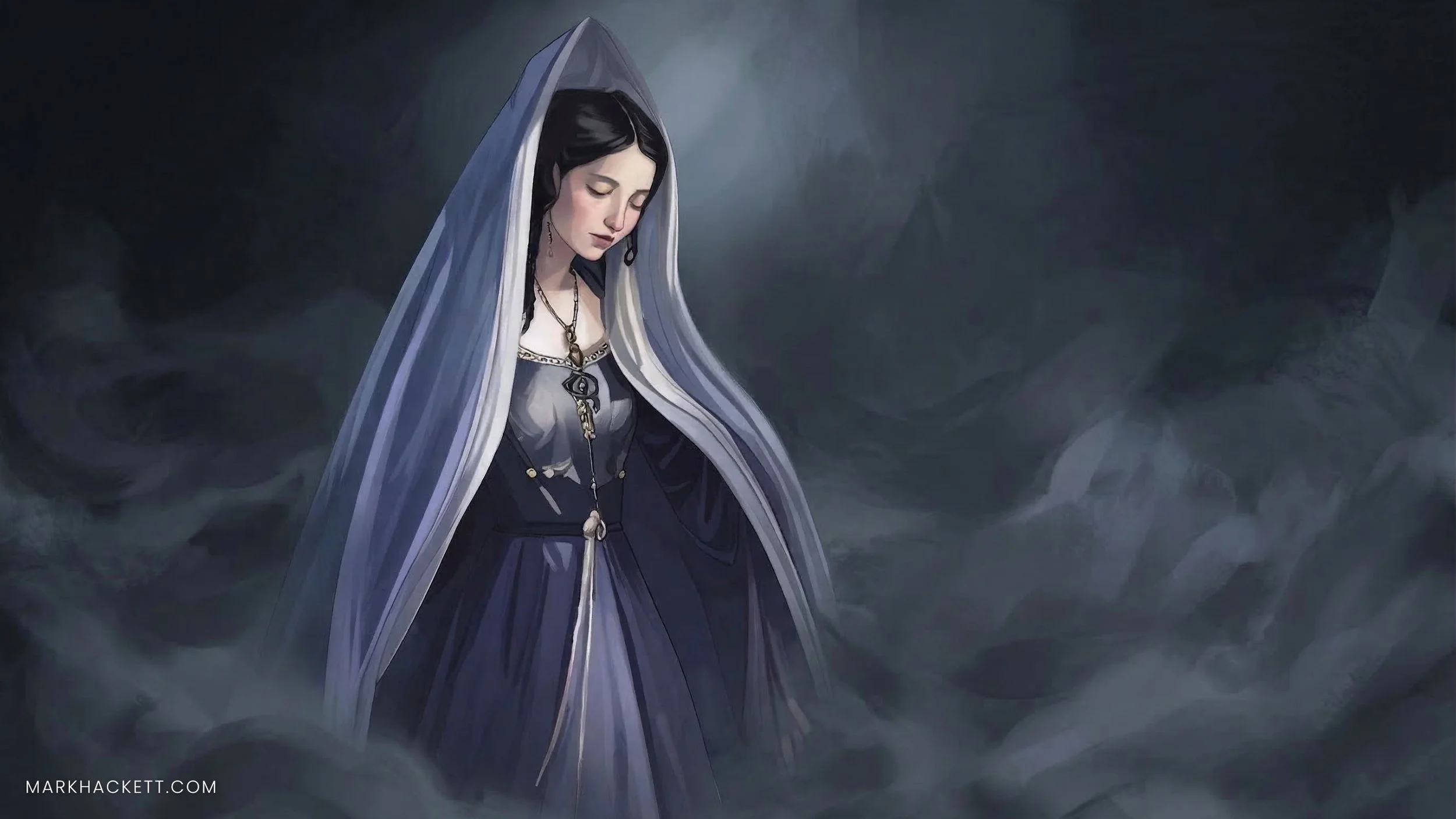
And yet, I can’t help but feel that Nienna’s heroic mourning in Tolkien’s secondary world seems glaringly absent from our own, especially in light of so much marring and death. I’m as guilty of not participating in mourning just as much as the next person. I feel the same urgency to act that so many do. I often feel there isn’t time to mourn.
So where to begin? Maybe the best place to start is by asking questions, questions such as:
If Nienna’s mourning flows throughout the history of Middle-earth, what could us mourning do for our time and those in times to come?
Would mourning today begin to change how we act and speak to one another? Would we become better friends and allies, and better trust friends and allies to do their part?
If we mourned, would we become less interested in the powerful and gaining power, and more interested in giving it up for the benefit of others?
In mourning, would we begin to see beauty where there appears to be none? Would we come to have more patience and pity? Pity that offers second chances? Grace extended that, even when pity fails to produce the results we desire, allows us to remain hopeful that it may lead to something good in ways we do not expect?
Are there people who came before us who mourned and, because they did, our world is not as dark today as it could be? Because their mourning led not only to correct action, but defiance in its most hopeful form?
I don’t know how Tolkien would have answered these questions; but, again, that’s not the point because Middle-earth is not an allegory. These deeper questions are as real as they are applicable though, regardless of what world they are asked in. The more I ask myself questions such as these, the more mourning feels less of a strange thing. Mourning begins to feel as urgent as the emergencies we see around us. Mourning begins to feel like the place hope begins.
Closing Thoughts
Like Nienna, I don’t know where mourning in our context ultimately leads. What makes eucatastrophe —a happy ending— so overwhelmingly beautiful is that, from our perspective, the opposite is likely to come to pass instead: more death and harm. The Unhappy Ending. Doing the right thing the right way for the right reasons does not guarantee a just outcome in neither the primary nor secondary worlds.
What I think I understand now though is this: our world does not have to be shaped by evil deeds so much as it can be shaped by the mourning of those deeds.
Our extreme individualism in America makes us feel a natural pull toward the power of Gandalf, the bravery and skill of Aragorn, and the strength of so many of Tolkien’s more obvious heroes. To be sure, there is much to admire and aspire to in these characters, even at surface-level. But so much of this strength and skill we see exists only because of what they learned in sorrow, and the lessons they took from unlikely heroes such as Nienna and what she exudes: that grief and evil and wrongdoing must, must be mourned.
True mourning puts solid ground beneath our feet, rooting us in our time and place in history. This helps lead us into right action in our immediate vicinity, washing away a bit of the filth of evil times and helping others see that hope is never truly lost. It is in mourning that we learn how to have patience and pity. Both equip us with the courage to stay in the fight for what is good and true over the long haul. Out of great mourning can come defiance and beauty. And out of defiance and beauty can come the completely unexpected.
Returning to James 4, mourning seems to be the starting point for the unseen road to the Ultimate Eucatastrophe. Not in our lifetime, but in the one that is still to come. The time when humanity has finally humbled itself before God, and God exalts us to the place we rightfully belong: atop the very pinnacle of Creation, continuing the work God began (Revelation 21-22). It will not happen in a Garden —for the Garden now lives in the mythic past— but in a city at the center of a new heavens and a new earth. In their book about Tolkien and his literary club, The Fellowship: The Literary Lives of the Inklings, Philip and Carol Zaleski sum this up well:
“A story that ends happily is, some believe, necessarily a sop to wishful thinking, a refusal to grow up. In ‘On Fairy-Stories’ —the closest we come to a manifesto for the Inklings' aesthetic—Tolkien turns this charge on its head, arguing that our deepest wishes, revealed by fairy stories and reawakened whenever we permit ourselves to enter with ‘literary belief’ into a secondary world, are not compensatory fantasies but glimpses of an absolute reality. When Sam Gamgee cries out, ‘O great glory and splendour! And all my wishes have come true!’ we are not in the realm of escapism, but of the Gospel, in all its strangeness and beauty.
Yet although the Inklings were guilty of the heresy of the Happy Ending, they were not optimists; they were war writers who understood that sacrifices must be made and that not all wounds will be healed in this life. Their belief in the Happy Ending was compatible with considerable anguish and uncertainty here below. One may be as gloomy as Puddleglum or as convinced as Frodo that ‘All my choices have proved ill’ without losing hope in a final redemption.”
Absent Nienna’s mourning there is no eucatastrophe in The Lord of the Rings, but Sauron’s victory instead. A permanent ruin. The Unhappiest of Endings for a beloved secondary world. How much more is this true in our primary world?
I hope I’ve understood Nienna well as one of the many Unlikely Heroes in Tolkien’s works. I hope she opens our eyes and draws us toward the Unlikely Heroes around us, and perhaps into being Unlikely Heroes ourselves.
“Namárië.”
About Me
I explore faith, church culture, and formation in the American South from my hometown of Memphis, TN. I’m an institutionalist who believes the means are just as important as the ends. Everything on this site is an expression of my faith and love for the Church.
Never miss an article by signing up for my newsletter and subscribing to the podcast. You can also become a member or leave a tip to help keep everything free and open to all.