Atonement for our times: Scapegoating no more
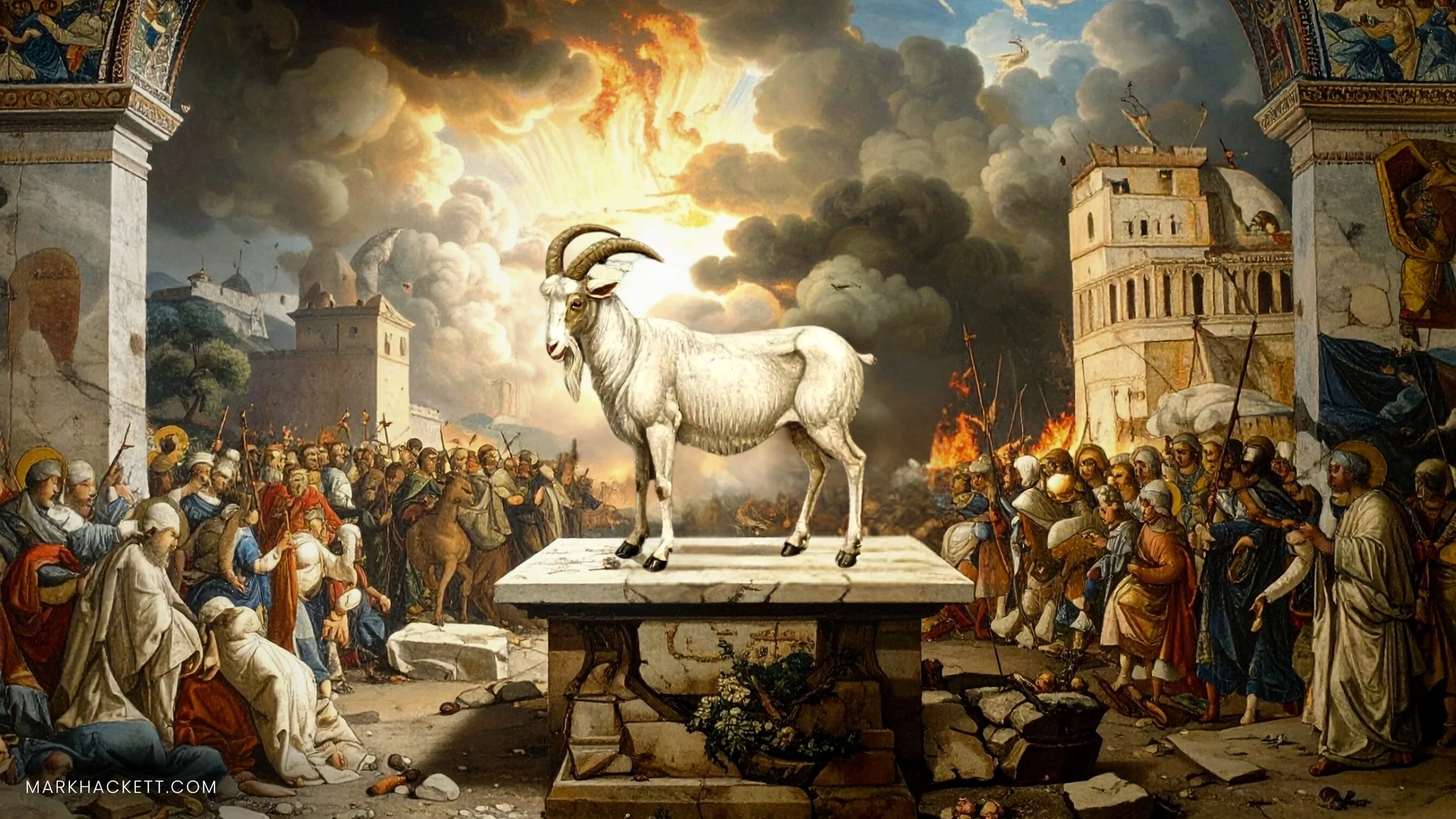
"Everywhere and always, when human beings either cannot or dare not take their anger out on the thing that has caused it, they unconsciously search for substitutes, and more often than not they find them."
- René Girard, The One by Whom Scandal Comes
•••••
Much of my writing, prayers, and conversations these days revolve around grasping at how to be whole. Some have suggested I’m seeking discipleship and recommended consumerist approaches and books on the topic. Given my evangelical past, a trip back down that road feels unappealing. Others have advised I lean into formative habits such as liturgy, contemplative prayer, and therapy. Sitting in the moments of silence that often come in the wake of all three has been a challenge, but I’ve found exploring older practices and receiving professional assistance to be more helpful than I expected.
I think I know what it means to be whole, both in finding peace in trying to imitate Jesus —the most genuine of humans— while being in touch with Our Father and neighbors as he was. It’s the how and getting there part that is a struggle. Working some of this out through negation has proven useful, mostly in trying to better understand the differences between sin, evil, brokenness, ignorance, honest human error, and finiteness. But in our individualist society, it feels we often miss external factors that play an outsized role in shaping us. I was recently struck by this line from Richard Rohr’s book Falling Upward:
“We all become a well disguised mirror image of anything that we fight too long or too directly. That which we oppose determines the energy and frames the questions after a while.”
Naturally, this led me to reconsider our political situation and what it’s doing to us as human beings. A little over a year ago and shortly after the 2024 election, I wrote these words:
“We know what comes next, or at least what Trump will try to do. The federal government faces a purge of dedicated civil servants who will be replaced with sycophants, human wrecking balls with no vision for healthy governance. Our communities are staring down the threat of federal agents and even the military ripping people from their homes and deporting them, including some who are citizens under the law. Extreme tariffs will send prices skyrocketing and inflict intense economic harm on families of all stripes. A weaponized Justice Department will target anyone who criticizes Trump, who knows he is basically immune from criminal prosecution. Republican war-mongering risks setting off a full-scale war in the Middle East, and the growing embrace of Vladimir Putin threatens to snuff out Ukraine as an independent nation-state.”
Much of this has since come to pass. There’s still plenty of time for the rest. All one had to do was take the right-wing at their word to have foresight. Be that as it may, it has often felt as if there has been too much to fight long and directly against with no end in sight. Our situation already “determines the energy and frames the questions,” leaving us at risk of becoming “a well disguised mirror image” of what we struggle against. I can’t think of any external menace that runs such a high risk of becoming internalized right now, that threatens to keep us from being whole.
Yet it often feels like we are missing the forest for the trees as we move from one daily outrage to the next. So what can be done? Probably a lot of things, but I think one is pursuing a better understanding of the pernicious systems underlying the dehumanization we see today. If being whole like Jesus in God the Father is to be pursued, then we have to know what the opposite looks like as well, and how that threatens not just us, but our neighbors.
One especially harmful system comes to mind. It’s one a lot of us Christians especially don’t like talking about.
An ancient system is thriving today
To live in America today is to be drowning in a modern form of an ancient practice: Scapegoating, or blaming a person or a group of people for the problems and faults of others who are innocent of what they are being accused of.
Some examples are more obvious than others, especially in the realm of politics and governance. On the political right it’s very specific, targeted moments like J.D. Vance blaming immigrants solely for America’s severe housing shortage, Mike Johnson charging young men who play video games of draining Medicaid, and Trump accusing Democrats of “cheating” when an election hasn’t even happened yet. Things play out more internally on the political left, with more moderate and progressive wings often blaming each other for problems they’ve both participated in. Centrists constantly scapegoat “the two extremes” for our national problems, refusing to take responsibility for worsening social conditions they refused to address during the many years they had the power to do so.
We’ve all experienced scapegoating in our personal lives at some point, too. Perhaps you were blamed for something you didn't do, or vice versa. Maybe it was over a job you did or didn’t get, in a relationship that failed, or at a church that did wrong by you and then blamed you for it. Regardless of what it was, this is all a very surface-level understanding of what is really going on. Scapegoating is more than just something we do to shirk responsibility; it’s a mechanism that can be ritualized for social ends. When we look back in history, we see almost all societies since ancient times have made this mechanism central to how they function.
The term scapegoat has origins in the Bible. From Leviticus 16:6–22:
“Aaron shall offer the bull as a purification offering for himself and shall make atonement for himself and for his house. He shall take the two goats and set them before the Lord at the entrance of the tent of meeting, and Aaron shall cast lots on the two goats, one lot for the Lord and the other lot for Azazel. Aaron shall present the goat on which the lot fell for the Lord and offer it as a purification offering, but the goat on which the lot fell for Azazel shall be presented alive before the Lord to make atonement over it, that it may be sent away into the wilderness to Azazel.
Aaron shall present the bull as a purification offering for himself and shall make atonement for himself and for his house; he shall slaughter the bull as a purification offering for himself. He shall take a censer full of coals of fire from the altar before the Lord and two handfuls of crushed sweet incense, and he shall bring it inside the curtain and put the incense on the fire before the Lord, that the cloud of the incense may shroud the cover that is upon the covenant, or he will die. He shall take some of the blood of the bull and sprinkle it with his finger on the front of the cover, and before the cover he shall sprinkle the blood with his finger seven times.
He shall slaughter the goat of the purification offering that is for the people and bring its blood inside the curtain and do with its blood as he did with the blood of the bull, sprinkling it upon the cover and before the cover. Thus he shall make atonement for the sanctuary, because of the uncleannesses of the Israelites and because of their transgressions, all their sins, and so he shall do for the tent of meeting, which remains with them in the midst of their uncleanness. No one shall be in the tent of meeting from the time he enters to make atonement in the sanctuary until he comes out and has made atonement for himself and for his house and for all the assembly of Israel. Then he shall go out to the altar that is before the Lord and make atonement on its behalf and shall take some of the blood of the bull and of the blood of the goat and put it on each of the horns of the altar. He shall sprinkle some of the blood on it with his finger seven times and cleanse it and sanctify it from the uncleannesses of the Israelites.
When he has finished atoning for the holy place and the tent of meeting and the altar, he shall present the live goat. Then Aaron shall lay both his hands on the head of the live goat and confess over it all the iniquities of the Israelites, and all their transgressions, all their sins, putting them on the head of the goat and sending it away into the wilderness by means of someone designated for the task. The goat shall bear on itself all their iniquities to a barren region, and the goat shall be set free in the wilderness.”
This passage comes out of a larger section about the Day of Atonement, the time each year the high priest would enter the Holy of Holies. What happens with this second goat —the scapegoat— in the wilderness is anyone’s guess. The word “azazel” is used, but its meaning has been debated by scholars. Early interpreters thought azazel was a spiritual being residing in the wilderness that this second goat went to. In more modern Christian contexts and many English translations today, the emphasis is on the goat itself and the part it plays in the atonement ritual, not what happens after the goat departs.
At first glance this feels different from how we use the term scapegoat today. Blame is being transferred from a people group —not just an individual— onto an animal. There is neither another person or group being blamed, nor does this happen off the cuff in a heated moment. The second goat escapes immediate harm as far as we know. This is scheduled and ritualized.

But scapegoating as we use the term is found elsewhere in Scripture, too. Adam blames Eve —and God!— for the incident at the Tree even though he was an active participant (Genesis 3:12). Cain murders Abel a mere one chapter later and, when God asks him where Abel is, Cain’s response is to push the blame onto anyone but himself: “I do not know; am I my brother’s keeper?” (Genesis 4). Sarai tells her husband Abram to have a child with her slave Hagar, as Sarai believed she would never have children, and then blames her husband and punishes Hagar when she becomes pregnant (Genesis 16).
If you’re sensing a pattern here it’s because there is one, and we haven’t even left Genesis yet. This pattern repeats itself generation after generation —from Saul blaming his problems on David to bouts of child sacrifice in Judahite culture (passing a child through the fire)— all the way into the New Testament and through to today. Why and how we scapegoat may have changed in some specific ways, but the idea of casting blame onto others and harming them for some sort of social utility remains the same.
It all begs the question: if scapegoating as we know it and this more ritualized form are both found in Scripture, is it possible the scapegoating we are witnessing today runs much deeper and is more dangerous than we realize?
Humanity’s slow journey to Scapegoat Theory
Scapegoating in its various forms has existed since the dawn of human civilization, but its purpose does not end at removing blame and placing it onto something or someone else. The ritual also preserves a semblance of peace inside a society, often without people realizing it. To understand this, we turn to the work of René Girard (1923-2015), the French academic, literary critic, and philosopher quoted at the top of this article.
While a number of academics, theologians, and others have observed the practice of scapegoating in history, Girard has been one of the most impactful voices on the subject. His research and thoughts are spread out among dozens of books, essays, and interviews; but, thankfully, a number of scholars are working to make Girard’s work more approachable. One such scholar, Dr. Jennifer Garcia Bashaw, writes in pages 2-4 of her book Scapegoats: The Gospel through the Eyes of Victims:
“Modern societies use scapegoats as well, but where the ancient practices involved the ritual of driving out or killing scapegoats, contemporary practices of scapegoating have expanded, appearing in new and different ways. Scapegoating today manifests itself in discrimination of all sorts—social, racial and ethnic, political, and religious. René Girard notes that ‘scapegoats multiply wherever human groups seek to lock themselves into a given identity—communal, local, national, ideological, racial, religious, and so on.’ But understanding that multiplication requires digging down its roots. ‘All discourses on exclusion, discrimination, racism, etc.,’ Girard argues, ‘will remain superficial as long as they don't address the religious foundations of the problems that besiege our society.’
For Girard, we have not moved beyond the ancient practices of ritual scapegoating, we have just become better at hiding them. Explicit forms of scapegoating (which ended in the killing of the scapegoat) have become more implicit, more insidious, and easier to ignore. How did this gradual evolution occur? Sociologist Tom Douglas argues that as societies developed, so did the function of scapegoating. When homogenous, religious communities gave way to larger, more diverse societies, religious atonement rituals no longer stood at the heart of the scapegoating process. The communal nature of scapegoating behavior moved from society as a whole to distinct societal segments. The transference of blame or responsibility continued to serve as a main motivation behind the creation of scapegoats, but individual (or small group) self-preservation rather than community preservation became its driving force. Douglas identifies four reasons that people or groups scapegoat others: ‘extreme dislike, fear, ignorance, and the displacement of blame from powerful originators to those perceived to be much weaker.’
Scapegoating no longer functions as a communal act meant to please the gods, but it still operates because of fear. Instead of dreading destruction from capricious divine powers, people who scapegoat today fear the loss of political, economic, or social power or the loss of tradition or a way of life. Some even use scapegoating in a strategic way. Much of the public scapegoating that occurs in the contemporary world stems from a fear of exposure; a person or group fears the destruction of their public image, and so they deflect blame in order to protect their own reputation or image.Although this modern scapegoating does not often end in death, it still causes suffering for its victims.”
Girard’s work begins with recognizing that our imitation of others and their desires are basic human behaviors. This can be good and necessary. For example, children learn language, love, and how to behave respectfully around others by imitating caring parents. Good imitation such as this is the heartbeat of sustaining healthy communities and is of great benefit to all kinds of relationships.
But imitation can also be a bad thing. As Girard studied everything from religion and myth in ancient cultures to children today fighting over a toy, he noticed a pattern: when two or more people desire something or another person, conflict breaks out, even violence. This violence leads to reciprocal violence and, when it goes on for long enough, more and more people imitate each other in harmful ways.
Such conditions cannot persist if humans are to survive. Girard suggests this is why humans have built cultural and social structures that help control and reduce violence. Early religion pushed the impulse for mimetic violence into ritual sacrifice (think of the passage from Leviticus 16 above). Rather than seeing people enter spirals of violence after being wronged or hurt, religious sacrifice allowed societies to place their sins, bad desires, and impulses toward violence onto a single victim, or a handful of them. This is what Girard calls “the scapegoat mechanism”, which united the community toward committing one act of violence together instead of many on each other. Cloaked in religious belief and laws, ritual practice, and powerful rhetoric, the scapegoat mechanism was largely hidden from the people participating in and even leading it.
Today we have a complex and ever-evolving system of governments, courts, laws and law enforcement, and civic institutions that keep the worst of mimetic violence at bay. Yet scapegoating mechanisms and their ritualization still exist. They remain largely hidden from us too, as Dr. Bashaw notes in her book.
Scapegoat Theory, then, is a grand theory, one that helps explain how large parts of societies function. Once you see what Girard points out in one time and place, you start to see it nearly every time and place, from the ancient Israelites to medieval European and colonial America witch hunts, from the Nazis blaming and mass murdering Jews and other vulnerable minorities to the Republican Party blaming immigrants for America’s problems today, before using the levers of government to abuse and deport them. Examples abound. Scapegoating is everywhere in history.
Unsurprisingly, many scapegoats across millennia share a common threat: they’re trapped inside the society that is scapegoating them but are often already marginalized, isolated, or powerless to save themselves. There’s a reason child sacrifice appears in the pages of the Bible and in ancient cultures: children are a largely defenseless group of people. Just like there is a reason a large swath of the American political system and people today have turned against immigrants, including those who are here legally and obeying the law: immigrants often have fewer resources and paths to protect themselves.
But there is good news, at least, there should be. One of the most intriguing conclusions of Girard’s research is that Christianity can be the remedy for scapegoating and other forms of mimetic violence. Why?
The Bible’s open confrontation with Scapegoating
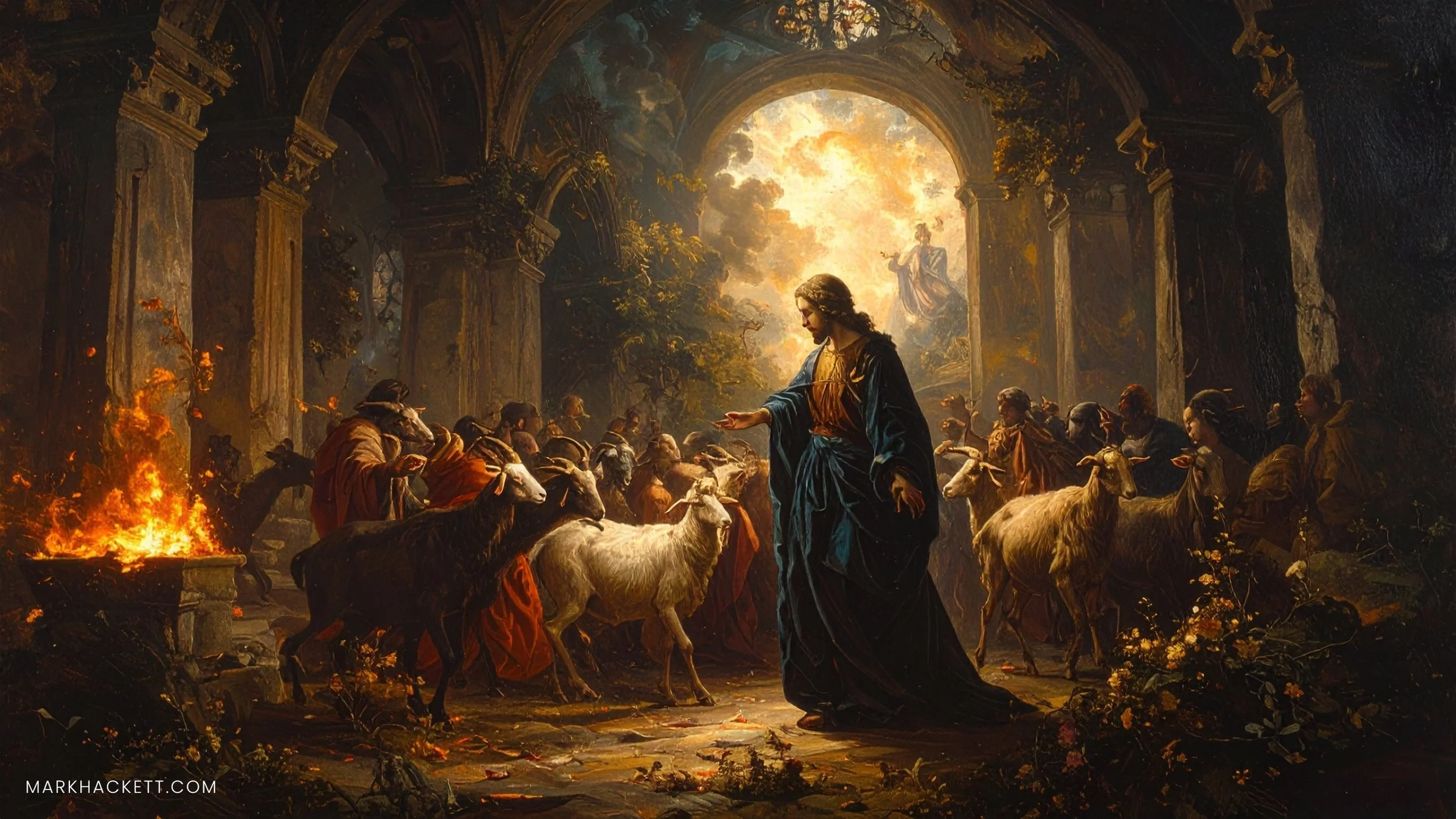
The stories found in the Bible do something other ancient religious texts do not: they fully expose the scapegoating mechanism and ritual for what they are, from Genesis to Revelation. The Old Testament is full of stories of human failure, people blaming others, and a society with clear scapegoating rituals built in. In 2 Kings, the majority of Israel’s monarchs are declared as being evil, with at least two of them engaging in child sacrifice (2 Kings 16:1-4, 2 Kings 21:1-16). The voices of scapegoated victims are sometimes centered in the biblical narrative, too, such as in the story of Hagar (Genesis 21:8-21). We could go on and on.
In the New Testament we see Jesus and the disciples interacting with the downtrodden, outcasts, and those blamed for the social problems of the day. And the Gospel accounts are not subtle in presenting Jesus as the Ultimate Scapegoat, showing in detail the innocence of the God-man who is tried and crucified at the insistence of a mob. In Things Hidden Since the Foundation of the World, Girard writes:
“Jesus is presented to us as the innocent victim of a group in crisis, which, for a time at any rate, is united against him. All the sub-groups and indeed all the individuals who are concerned with the life and trial of Jesus end up by giving their explicit or implicit assent to his death: the crowd in Jerusalem, the Jewish religious authorities, the Roman political authorities, and even the disciples, since those who do not betray or deny Jesus actively take flight or remain passive.
We must remember that this very crowd has welcomed Jesus with such enthusiasm only a few days earlier. The crowd turns around like a single man and insists on his death with a determination that springs at least in part from being carried away by the irrationality of the collective spirit. Certainly nothing has intervened to justify such a change of attitude.
It is necessary to have legal forms in a universe where there are legal institutions, to give unaniminity to the decision to put a man to death. Nonetheless, the decision to put Jesus to death is first and foremost a decision of the crowd, one that identifies the crucifixion not so much with a ritual sacrifice but (as in the case of the servant) with the process that I claim to be at the basis of all rituals and all religious phenomena. Just as in the ‘Songs’ from Isaiah, though even more directly this hypothesis confronts us in the four gospel stories of the Passion.
Because it reproduces the founding event of all rituals, the Passion is connected with every ritual on the entire planet. There is not an incident in it that cannot be found in countless instances: the preliminary trial, the derisive crowd, the grotesque honours accorded to the victim, and the particular role played by chance, in the form of casting lots, which here affects not the choice of the victim but the way in which his clothing is disposed of. The final feature is the degrading punishment that takes place outside the holy city in order not to contaminate it.
Simply put, the Bible doesn’t hide scapegoating. The authors point directly to it and, much like Abel’s blood crying up from the ground (Genesis 4:10), shout loudly “Do you see what has been done?”
Scapegoating ebbs and flows throughout Scripture just as it still does today, but it never fully disappears. In fact, it often comes roaring back in times of social crisis, which we will examine in our context momentarily. But first we must address the elephant in the room: if the Christian tradition can end scapegoating, why hasn’t it? And why are so many churches and Christians today scapegoating others?
The blinders of Penal Substitution in American church culture
All of the above has far-reaching ramifications for our understanding of atonement and daily life, especially for those of us swimming in the waters of Penal Substitutionary Atonement (PSA) in cultural evangelicalism.
Through the lens of Scapegoat Theory, the story of Jesus is one of scapegoating violence being defeated. In his miraculous birth God became vulnerable (Philippians 2:5-8). In his life he laid out a new pattern for how we are to live (John 13:15), one that pointedly rejects scapegoating and othering (John 4:1-42). In the lead up to the Cross, Jesus became the victim of one of humanity’s worst sins (Luke 22-23). In his death he exposed the scapegoating mechanism in totality (Luke 23:44-49). And in his resurrection he overcame and defeated the dark ritual itself (Luke 24:1-12). Indeed, Jesus as the scapegoated victim becomes the very foundation that the Kingdom of God is built on (1 Corinthians 3:10-15). He doesn’t just die for us, but ahead of us so we may live as he did and join him.
This is starkly different from the highly individualistic Jesus-died-for-me-and-my-sins-and-nothing-else vibe found in much of American evangelicalism, or what Dallas Willard called the “Vampire Christian,” who:
“…in effect says to Jesus: ‘I'd like a little of your blood, please. But I don't care to be your student or have your character. In fact, won't you just excuse me while I get on with my life, and I'll see you in heaven.’”
Obviously this description can be a caricature. I know good and kind evangelicals who take their faith and love for neighbor as seriously as they do the theory of PSA, but Willard’s description still hits the bullseye with far too much frequency. White evangelicalism is often felt to be hostile, angry, oppressive, and fearful for lots of insular reasons, one of which being how the theory of PSA is understood, taught, and popularly enforced in evangelical spaces. Teaching affects culture and culture affects teaching, regardless of it is good or bad.
Penal Substitution varies from place to place, but it often goes something like this: individuals are guilty of sin and this has separated us from God. We are born into it and are not capable of bridging the divide. We are threatened by God’s wrath as a result. We need a savior from God’s wrath, so God provided His son Jesus and punished him in our place. Believing Jesus replaced what should have been me on the cross means I am saved.
Again, this is not the only interpretation of PSA. I am simply describing how it is often pitched from pulpits in my neck of the woods. There are healthier versions emphasizing God’s holiness and love over notions of wrath. People ascribing to such strains seem to be much more thoughtful, kind, and curious for it. Like Jesus said, “You will know them by their fruits.” (Matthew 7:15-20)
But even healthier forms of penal substitutionary culture run a high risk of blinding us from the bigger picture of what God is doing in the world. PSA is also a grand theory; however, in cultural evangelicalism, Penal Substitution is often the only grand theory permitted. Harsher styles of PSA especially are equated as being The Gospel to such an extreme degree that those in the fold are wholly unaware other theories of atonement and understandings of God exist. This has all manner of negative knock-on effects, from narrowing what is allowed to be discussed in biblical interpretation to equating brokenness and finiteness with sin and evil, from individualizing all sin to rejecting the fact that sin can be systemic, to confusing painful and unjust ancient cultural practices with being biblical.
But we also must recognize a less obvious truth: PSA was already difficult to connect with at the turn of the century and is even more so now as we move further into postmodernity. This disenchantment with the only theory of atonement so many churches are built on seems to be a more unstated yet serious driver of the exodus from churches we are seeing. To briefly examine just one example, several years ago a well-known, very mainstream evangelical leader gave a sermon entitled “The Kingdom of God Is Not Good News”. Here’s an excerpt:
“Yes, Jesus reigns. Yes, the King and the kingdom have come. But, no, that is not good news. I get frankly very tired of people building their theologies around that as good news. It’s not — not without blood, and his in particular. Not without substitution. There is no good news in the resurrection of Jesus. I’m going to be slaughtered by this deathless king. No good news in his reign. No good news in his coming. Not until he becomes a bloody Savior do I feel any hope at all before the reign of God Almighty…
And now, for all of us who are in Christ, the wrath of God is spent and justice is satisfied and what makes that good news is that when he died, he bought for his own faith in Jesus Christ, resurrection from spiritual death, eternal life, forgiveness of sins, justification, or the imputation of his own righteousness, peace with God, escape from hell, and the enjoyment of all the new covenant promises, the best and highest of which is, ‘I will be your God, and I will be with you, and you will be my people.’”
I’ve been a Christian my whole life and read my Bibles a lot. The older I’ve gotten, the less and less I understand or can relate to this articulation of PSA. The first part makes God sound like a tyrant and ignores the life of Jesus. In the second part, the language of sacrifice reduces God to something akin to a math formula that needs to be worked out. It all sounds hollow, even incomprehensible at points.
Yet beliefs like this still impact everything inside churches, perhaps most visibly in Sunday morning worship services which regularly mention blood in songs and sermons. This despite virtually none of us having watched an animal be ritually sacrificed, and I certainly hope none of us has stood by and watched a human being be crucified. PSA offers a picture of God and salvation that is difficult to relate with, even when it is taught in healthier ways. Indeed, using the logic found in the above sermon, one could easily argue the morally right thing to do is to live in open rebel against such an angry god who set us up to fail.

Thankfully, throughout Scripture, we see God meeting people where they are —both the scapegoated and those who are scapegoating– whether it’s Hagar by the spring (Genesis 16) or Saul on the road to Damascus (Acts 9). He negotiates, changes His mind even, such as with Moses on the mountain (Exodus 32:11-14). He is not only a God who exists outside of time and space; He intentionally enters into it for our gain (Luke 2). He is the Living and Present God, not a formula in need of solving. Jesus listens and sees and responds to the needs of those around him (Matthew 14:13-21). All of this is, always has been, and always will be Good News. How much more so in these times of disenchantment, deconstruction, and theological and church failure?
I understand that some readers feel uncomfortable with some of the above. Me too. I’ve written about my frustrations with penal substitution in this cultural context before and, while my views on the theory itself are even more dim today than they were just a few years ago, I’m not immune from this set of beliefs and culture I came out of but am still shaped by, likely in ways I don’t fully understand.
So let me offer this before continuing on: as a practical matter, you can take the idea of Jesus dying for your sins seriously while also believing atonement does not have to begin and end there. Jesus dying for our sins isn’t mutually exclusive from his showing us how we can participate in bringing Heaven to Earth (Romans 12). Our Savior overcoming the evils of this world by dying at the hands of a brutal empire does not mean salvation is impersonal (Colossians 2:11-15). Scapegoat Theory may be hard for some people to swallow at first; but, when placed alongside other theories of atonement, it emphasizes Jesus’ life and ministry in a way other theories fail to do.
If the Kingdom of God really is all things being made new, then atonement simply cannot place you at the center of the redemptive universe. My fear is that, in our cultural context, penal substitution far too often centers us as individuals over Jesus and neighbor. It is no wonder that scapegoating thrives in our churches today when such extreme individualism persist.
We can and we must do better.
Atonement in these times between the times
One of the many benefits of accepting the broader view of atonement and salvation presented in Scripture is that the Christian faith is always relevant and earnest. Scapegoat Theory is not only deeply rooted in Scripture; it makes the concept of sacrifice much more relatable and urgent than PSA does. We are living with skyrocketing levels of scapegoating today, some examples of which I provided near the beginning of this article. More examples abound, including very recently.
In the wake of the deplorable slaying of Charlie Kirk, the American right-wing blamed people who promote transgender and leftist and antifascist ideology, despite there being little to no evidence for making such claims. Fox News regularly uses scapegoating rhetoric, such as one host saying of homeless people “Involuntary lethal injection, or something. Just kill them.” At the time of this posting, the Trump Administration is still rounding up and deporting people who are here legally and cooperating with the immigration system as they were asked to, even as the administration blames them for a slew of social problems they have nothing to do with. Many of these people have no criminal record. Some have been tortured and sexually assaulted in the aftermath, a fact Trump-friendly media has tried to cover up.
Christians should have a lot to say considering that our Savior was the Ultimate Scapegoat. Because we ignore the biblical authors pointing to scapegoating while locking our focus on hyper-individualistic salvation, far too many who claim the name of Jesus are silent right now, including some who are sincerely upset with the hatred we are seeing in our society. As such, as we begin considering what scapegoating today means for atonement in these times between the times, there are two issues we must be aware of.
First, it’s one thing for people who sincerely want to follow Jesus to become aware of scapegoating and start responding to it as Jesus would. It’s another thing entirely for bad actors to know how scapegoating works while knowing that most people are unconscious of the practice. The latter can easily weaponize scapegoating for their own gain and to commit further harm. This is not a hypothetical. In September 2024, Politico published a searing article about this exact situation concerning J.D. Vance , a few excerpts of which follows:
“Vance has reflected articulately —and even eloquently— about Girard’s theory of the scapegoat. Discussing Girard in a 2020 article about his conversion to Catholicism…Vance wrote: ‘In Christ, we see our efforts to shift blame and our own inadequacies onto a victim for what they are: a moral failing, projected violently upon someone else. Christ is the scapegoat who reveals our imperfections, and forces us to look at our own flaws rather than blame our society’s chosen victims.’…That realization prompted a change of heart in Vance: ‘That all had to change. It was time to stop scapegoating and focus on what I could do to improve things.’
Five years after writing these lines, Vance appears to have reversed course. Why? Scholars of Girard may offer one possible answer. Though Girard never said so outright, some of his interpreters have argued that Girard’s idea of the Christian ethic —which in theory offers an alternative to ritualistic violence as a basis for social cohesion— cannot in practice serve as the basis for a large, complex and modern society. As one scholar of Girard has written, ‘The gospel story is not a myth uniting the entire social order.’ In other words, although an elite spiritual minority may take up Christianity as its guiding ethic, the majority of mass society will continue to require some amount of ritual violence to preserve itself. According to this formulation, scapegoating is not only inevitable but useful, insofar as it builds social cohesion among large, otherwise diverse groups of people.
Vance has not explicitly endorsed this idea, but echoes of it are discernible in Vance’s past comments about the foundation of the American nation…And if mass society needs some amount of ritualistic violence to maintain itself, Vance appears ready to let it play out—having defended his comments even after several schools and municipal buildings in Springfield were evacuated due to bomb threats. Meanwhile, the city’s Haitian residents —many of whom are there legally through a federal resettlement program— have faced a precipitous rise in threats and harassment…
‘If I have to create stories so that the American media actually pays attention to the suffering of the American people, then that’s what I’m going to do,’ Vance said in an interview with CNN on Sunday. He later clarified that he meant that he was ‘creating the America media focusing on it,’ but the suggestion was the same: Vance is consciously stoking the conflict to promote cohesion among his native-born political base, even if doing so results in real threats of violence against Springfield’s non-native population.”
Vance is far from the only government official in American history who has engaged in the scapegoating of immigrants. But he does seem to be one of the few political elites who is fully aware of the dark ritual he is participating in. This is harm being done not out of genuine ignorance, but out of a place of true knowledge. And because so few of us understand the scapegoat mechanism as well as Vance does, he has never been directly confronted for it. We must ask ourselves how Jesus would challenge Vance concerning all of this to help guide ourselves in our own words and actions.
Second and grimly, all of this forces us to wrestle with the question of if our society requires some amount of ritual violence to survive. Vance seems to believe earnestly that we do and is acting on that belief. More importantly, we must recognize that once more people in a society are exposed to the scapegoating mechanism and rightfully decide to end it, there is a risk that we lose the ability to limit mimetic violence, risking ever-growing levels of discord that ends in utter catastrophe. Americans have long believed in the falsehood “it can’t happen here” when seeing mass violence in other countries, when in fact it has already happened before in our own civil war and in other times of political violence in our history.
The Good News is that Jesus replaced the myth of vindication in violence with the truth of redemptive suffering. He showed us how to let the pain of scapegoating change us, how to disciple ourselves out of scapegoating in a way that does not end in disaster. He set a new pattern for our daily living, teaching us how to forgive and how to love our neighbors. The more of us trying to do all of this, the better.
The kind of penal substitutionary culture described above leaves no clear path to learning how to act responsibly in times of social crisis. In some environments the theory even leads people into authoritarianism and a desire for violence, as false beliefs that harm creates order and punishment equals justice take over. When notions of divine violence are turned into an idol —i.e. Jesus was punished or killed for my sins— the skids are greased to wish violence upon others you disagree with or think are wrong. Far too often, we focus on a narrow interpretation of the Cross, cherry picking the parts of Jesus’s life that we like as we downplay the parts we find inconvenient, and cultivating noxious social and cognitive effects from a severe misunderstanding of the Cross.
Indeed, it is because innocent bloodshed on the Cross is glorified through the near-sightedness of cultural PSA that modern abusers are still demanding well-meaning Christians accept the suffering being inflicted on them because it is Christlike to do so. The picture of God punishing His innocent Son on the Cross, to satisfy His wrath, has been wielded far too often to justify spousal and child abuse. Some evangelicals even fetishize being persecuted because Jesus was persecuted, or convince themselves they are being persecuted in the face of the most mild disagreements. Others wish or openly call for state-sanctioned violence against their neighbors.
We know that cultural PSA is not the only Christian environment this darkness infects. Throughout history, it was neither images of the Manger nor Empty Tomb born aloft at the vanguard of Christians committing pogroms, witch hunts, and crusades. It was the Cross. All manner of Empire and Mammon has been committed as Christians misunderstand the meaning of the Cross.
I am not suggesting that we ignore the death of Jesus. I’ve just come to believe we don’t have a solid grasp on the meaning of that unfathomably gruesome moment. The real power of the Cross is that it doesn’t demand retaliation. It doesn’t shame us because it isn’t about punishment. The Cross is a symbol of love so deep that it humanizes, even in times when dehumanization is rampant. The story of Jesus as viewed through Scapegoat Theory provides a path forward in times of crisis in ways penal substitutionary culture often can’t.
Closing Thoughts
How are we made whole? How can we move forward when so many self-proclaimed Christians flagrantly scapegoat others? What does atonement look like for these times between the times? How do we know when we are in God’s Kingdom, or standing outside of it?
There is no path through these questions without addressing the scapegoat mechanism. It is the penultimate anti-neighbor ritual, therefore it is anti-God (Matthew 22:34-39). The notion of the so-called “sin of empathy” being pushed into countless churches today is not only antichrist, it is crafted to perpetuate and expand the scapegoating ritual. It is a self-imposed barrier between us and the divine, closing off the path to the Kingdom entirely.
It is not enough to avoid participation in scapegoating. This dark ritual is the sin at the root of countless others. We cannot see this through mere individualist eyes, and not just because scapegoating has major social implications. Atonement for our times can neither be achieved by the way of the Vampire Christian, nor found in vague platitudes about justice and fairness.
Why not? Because ending scapegoating is fundamentally eschatological.
One day, scapegoating will come to an end, or at least be so severely diminished that the barrier between this world and eternity will begin to fade, until we find ourselves standing on the very edge of eternity itself. A new humanity that, through the Spirit and the difficult work of repentance, healing, and repair, has opened the world to the coming of Heaven. Revelation 21 gives us a tiny glimpse of what this will mean:
“Then I saw a new heaven and a new earth, for the first heaven and the first earth had passed away, and the sea was no more. And I saw the holy city, the new Jerusalem, coming down out of heaven from God, prepared as a bride adorned for her husband. And I heard a loud voice from the throne saying, ‘See, the home of God is among mortals. He will dwell with them; they will be his peoples, and God himself will be with them and be their God; he will wipe every tear from their eyes. Death will be no more; mourning and crying and pain will be no more, for the first things have passed away.’”
This future simply cannot be as long as scapegoating is permitted. There are real villains today who must be confronted with the peace of Christ. Along the way we will learn just how easily we can become “a well disguised mirror image of anything that we fight too long or too directly.” To battle scapegoating is to learn just how effortlessly we scapegoat others, including those who are engaged in scapegoating, including ourselves. Yet I have hope the Spirit is showing more and more of us just how broken many versions of discipleship and evangelism are today, broken understandings that keep us from seeing justice become reality, a hard truth that those who are being scapegoated feel all too acutely.
If the story of the life, death, and resurrection of Jesus is the beginning of all things made new, then Jesus is also the beginning of the end of “the first things” we see in Revelation. Salvation and atonement offered by the God-man will be completed in its kaleidoscopic nature (Hebrews 12:1-13).
This includes the truth that, in Jesus, the power of God became vulnerable so as to meet the vulnerable in intimacy. It was in this vulnerability he showed us a new way of being human. He became the Ultimate Scapegoat on the Cross and, in his resurrection, conquered the dark ritual by overcoming death itself, gifting us the ability to follow him until we scapegoat no more.
This is Good News, a call we are invited to live into that we would do well to embrace.

About Me
I explore faith, church culture, and formation in the American South from my hometown of Memphis, TN. I’m an institutionalist who believes the means are just as important as the ends. Everything on this site is an expression of my faith and love for the Church.
Never miss an article by signing up for my newsletter and subscribing to the podcast. You can also become a member or leave a tip to help keep everything free and open to all.